Behind every clean, audit-ready bottle of capsules, every consistent dose of liquid tonic, and every premium three-panel label sits a tightly engineered packaging line. For Hong Kong supplement brands operating in one of the world's most competitive consumer health markets, packaging is no longer the last step of OEM — it is the operational bottleneck where compliance, cost, throughput and brand perception all converge.
This in-depth guide breaks down how a modern automated supplement packaging line really works in 2026: the physics of solid-dose counting, the metrology of liquid filling, the servo electronics of multi-panel labelling, the validation logic of induction sealing, and the embedded QC checkpoints that distinguish an audit-ready facility from a hobbyist operation. We close with capacity planning realities for Hong Kong, regulatory expectations across export markets, an extended FAQ, and where ACC+ fits in the supplement OEM landscape.
Most supplement founders we meet at ACC+ have spent months perfecting their formulation, ingredient sourcing and outer-box design. Yet on the production floor, the variable that consistently makes or breaks a launch is not the formula — it is the packaging line. A high-quality powder can fail acceptance testing because of moisture intrusion through a poorly seated induction seal. A premium-priced collagen tonic can be recalled because a dosing piston drifted 1.4% over a shift. A bilingual SKU can be rejected at port because the neck label slipped 1.2 mm and clipped a regulatory icon.
This is why serious brand owners now interview their OEM partner on packaging-line topology before they discuss MOQ or unit price. The questions worth asking are technical: what is the counter type, what is the filler accuracy across viscosity bands, how is the line cleared between SKUs, where does the check-weigher sit relative to the metal detector, and what does the master batch record look like for QC release?
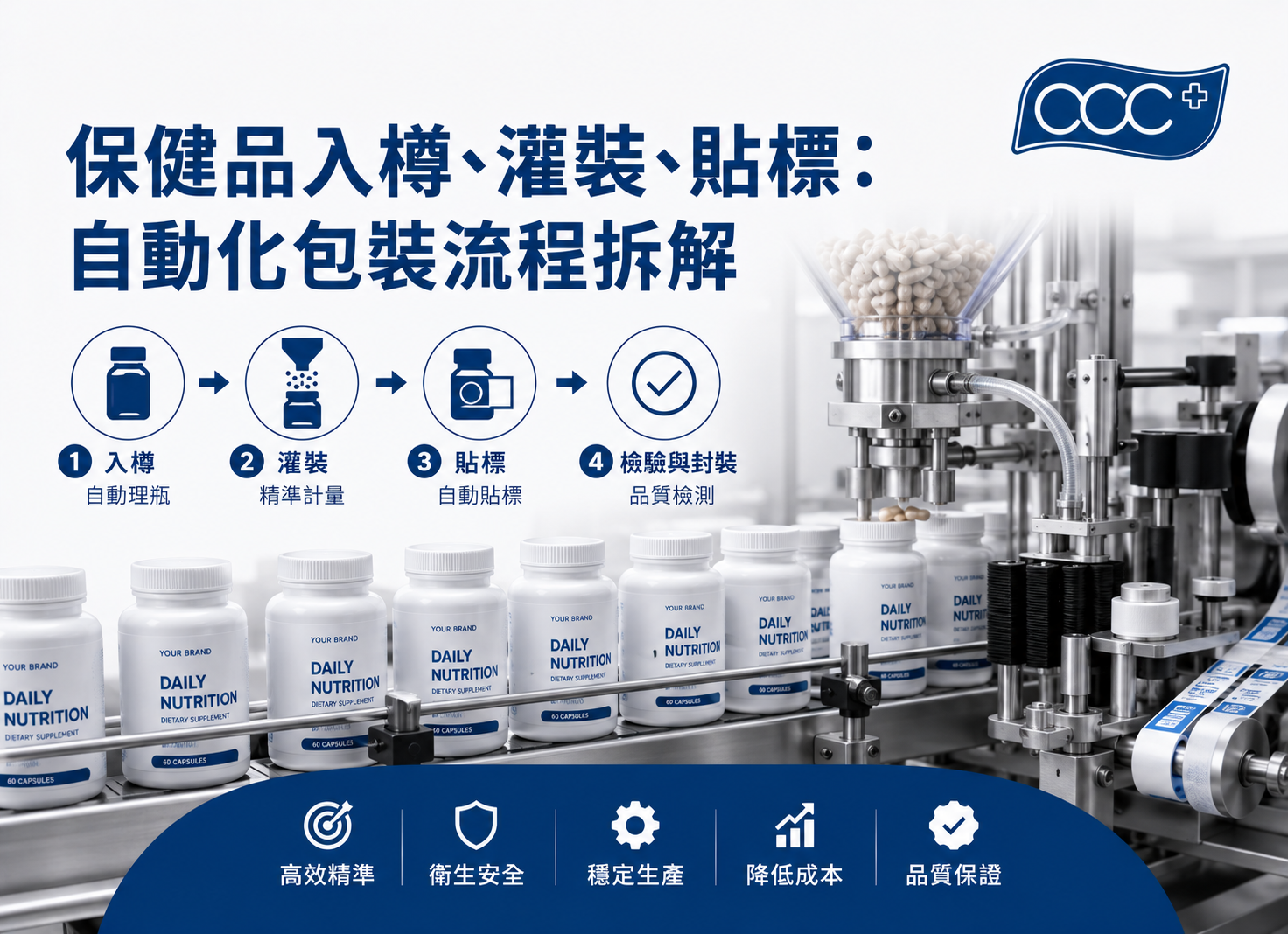
Solid-dose bottling covers capsules, tablets, softgels, gummies, mini-tabs and chewables. Although each unit type has its own mechanical quirks, the underlying line architecture follows a common pattern: orient empty bottle, count or weigh dose, insert desiccant or cotton, cap, induction seal, label, code, inspect, pack.
The workhorse of solid-dose packaging in Hong Kong supplement plants is the electronic channel counter. Units are vibrated into parallel channels — typically 8, 12, 16 or 24 lanes for benchtop to industrial models — and pass through a curtain of infrared or photoelectric sensors. Each interruption is counted and assigned to a specific bottle moving on a synchronised indexer below. Accuracy is consistently within ±1 unit per bottle when units fall inside the validated size and shape envelope.
Critical considerations for counter selection include the dose-per-bottle range (a 30-count bottle and a 240-count bottle have very different ergonomics), capsule polish (matte gelatin behaves differently from glossy HPMC), and gummy stickiness (high-pectin gummies need silicone-coated channels to prevent agglomeration). A well-specified counter handles all of these with quick changeover — typically under 30 minutes between SKUs of similar geometry.
Not every supplement can be counted. Collagen peptide jars, protein powders, fibre powders, electrolyte sachets and irregularly shaped chewables are filled by net weight or volumetric displacement. Net-weight fillers use load-cell feedback to dose to a target gram value, typically holding ±1% to ±2% depending on flow characteristics. Volumetric augers are faster but rely on consistent bulk density, which is why powder formulations destined for auger filling must pass density and flow validation before scale-up.
Vitamin C, probiotics, omega-3 softgels and many botanical extracts are hygroscopic or oxidation-sensitive. Inline desiccant inserters drop a silica or molecular-sieve canister into each bottle before capping, while cotton inserters add a polyester or rayon coil to immobilise solid units in transit. Both stations are interlocked with the bottle indexer — if the indexer pauses, the inserter pauses, eliminating the classic failure mode of two desiccants in one bottle and none in the next.
Capping torque is a quality attribute, not a cosmetic preference. Under-torqued caps allow oxygen and humidity ingress; over-torqued caps strip the bottle thread or crack the closure liner. Modern lines use servo cappers with closed-loop torque feedback, typically targeting 15–25 in-lb for standard 38 mm CT caps. Downstream, an induction sealer melts the foil-laminate liner onto the bottle rim using an electromagnetic field, creating a tamper-evident hermetic seal. Seal integrity is verified by torque-back testing and burst testing on retain samples.
Liquid supplement filling is a fundamentally different discipline from solid-dose bottling. Where solid lines worry about count and weight, liquid lines worry about viscosity, foaming, dosing repeatability, cleanroom particulates and microbial control. A 60 ml collagen shot, a 250 ml herbal tonic and a 2 ml ampoule each demand a different filler architecture.
Piston fillers — high accuracy (±0.5% to ±1%) across medium-to-high viscosity products such as syrups, honey-based tonics and emulsions. Mechanically robust but require thorough CIP between SKUs.
Peristaltic fillers — single-use tubing path means no product contact with stainless steel, ideal for sensitive actives and small-batch luxury liquids. Slower throughput and tubing is a recurring consumable.
Net-weight fillers — load-cell verified dosing, the gold standard for high-value liquids where every milligram of active matters.
Time-pressure fillers — fastest cycle times for low-viscosity water-thin liquids, but accuracy degrades if upstream pressure fluctuates.
Sensitive liquid supplements — particularly those without preservative systems or with probiotic actives — are filled under ISO 7 (Class 10,000) or ISO 8 conditions, with HEPA-filtered laminar flow over the filling needles. Continuous particle monitoring and scheduled microbial settle plates verify that the environment stays within validated limits throughout the run. Operators gown to defined procedures, and the cleanroom runs at positive pressure relative to adjacent corridors.
Between SKUs, liquid lines execute a clean-in-place (CIP) cycle: alkaline wash, water rinse, acid wash, final water rinse, hot-water or steam sanitisation. For aseptic or low-bioburden products, sterilise-in-place (SIP) follows with saturated steam at validated temperature and dwell time. The CIP / SIP cycles are documented per batch and verified by riboflavin coverage tests during initial validation and periodic requalification. This is the single most expensive recurring activity on a liquid line, which is why filling is typically scheduled in product-family campaigns rather than ad-hoc SKU rotations.
Liquid supplement bottles use one of three sealing strategies: foil seal plus screw cap (the dominant choice for shots and tonics, combining tamper evidence with oxygen and light barrier), crimp-sealed ampoules (for single-dose precision and absolute seal integrity), or twist-off PET caps with tamper bands (for value-tier products). The choice cascades upstream into bottle design and downstream into shelf-life validation.
Labelling on a 2026 supplement line is closer to robotics than to packaging in the traditional sense. A premium three-panel applicator uses servo motors, optical fiducial registration and real-time vision feedback to apply front, back and neck or top labels in a single pass at tolerances around ±0.5 mm. The accuracy matters not only for aesthetics but for regulatory compliance: a slipped neck label can obscure a mandatory bilingual warning, an allergen declaration, or a barcode.
Single-panel applicators handle simple cylindrical bottles. Two-panel (front and back wrap) is the workhorse for value-tier supplements. Three-panel adds a neck or top label and is the standard for premium SKUs, bilingual mandatory text, and any product that must display lot, expiry, and serialisation on a tamper-evident surface. Four-panel and shrink-sleeve applicators serve specialised categories such as multi-language export SKUs and cylindrical metal cans.
Every labelled bottle passes under a vision camera that verifies label presence, alignment, barcode readability (1D and 2D), human-readable date and lot codes, and — increasingly — serialisation data matrices for export markets with track-and-trace requirements. Failed bottles are diverted to a reject lane by a precise air-blast or pusher, not by operator intervention. The reject rate is recorded against batch tolerances and triggers line stoppage if it exceeds threshold.
Inkjet or laser coders apply lot number and expiry directly from the batch master record. Date format must match destination market — DD/MM/YYYY for Hong Kong, the EU, and most Commonwealth markets; MM/DD/YYYY for the United States; YYYY-MM-DD for ISO-compliant ASEAN markets and most institutional channels. Serialisation (GS1 DataMatrix with GTIN, lot, expiry and serial) is required for some pharmaceutical-adjacent supplement categories exporting to the US, EU and South Korea.
Equipment alone does not deliver compliance. The line architecture must embed QC checkpoints that are non-negotiable, automated where possible, and documented in real time. Below is the checkpoint stack that ACC+ and other GMP-certified Hong Kong facilities run as a minimum standard.
At the start of every batch, the first 5 to 20 finished units are pulled and inspected against the master specification: count or net weight, cap torque, induction seal integrity, label position, barcode scan, lot and expiry coding, and visual cosmetic check. The line is held in pause until QC signs the FAI record. Catching dosing drift, label mis-application or coding errors at unit 10 instead of unit 10,000 is the single highest-leverage QC practice in modern supplement packaging.
Every bottle passes through a high-speed check-weigher that verifies net weight against the validated tolerance band. Out-of-tolerance units are rejected without operator judgement. The check-weigher logs gross, tare and net mass for every unit, providing a real-time control chart that flags trend drift before it becomes an out-of-spec event.
Metal detectors are calibrated daily with ferrous, non-ferrous and stainless test pieces of validated sensitivity. X-ray systems extend detection to glass, dense plastic and bone fragments. For tablet and capsule lines, metal detection guards against wear fragments from compression tooling, capsule filling pins and counter channels. For powder lines, X-ray adds protection against foreign particles introduced during raw-material handling.
Statistically representative retain samples are pulled from each batch and stored under controlled temperature and humidity for the full labelled shelf life plus a margin. Stability programmes pull retain units at defined intervals (typically 0, 3, 6, 9, 12, 18, 24 months) and re-test against release specifications, generating the data that supports the printed expiry date. Retain samples also enable post-market complaint investigation without re-opening sealed customer units.
Between SKUs, line clearance procedures are documented and signed: empty hoppers, remove all loose units, vacuum or wipe contact surfaces, change tooling, and verify cleanliness against allergen swab protocols where applicable. The clearance record is part of the batch master record. Allergens of regulatory concern in Hong Kong supplements include milk, soy, egg, gluten, peanuts, tree nuts, fish, shellfish and certain botanicals — and these must be controlled through both physical segregation and validated cleaning.
Equipment brochures quote nameplate speeds — bottles per minute under ideal conditions, with no changeover, no QC sampling and no SKU complexity. Real-world throughput is typically 50% to 70% of nameplate once you account for changeover, FAI hold, QC release, and operator breaks. Realistic planning numbers for Hong Kong supplement OEM lines look like this:
Electronic counter line (capsules/tablets): 60 to 120 bottles per minute sustained, equating to 25,000–50,000 bottles per 8-hour shift depending on dose-per-bottle and changeover cadence.
Gummy line: 40 to 80 bottles per minute, slower due to sticky-unit handling and softer mechanical tolerances.
Liquid filling line (shots/tonics): 30 to 80 units per minute for piston fillers; lower for peristaltic and aseptic configurations.
Ampoule line: 100 to 300 ampoules per minute for high-speed crimp-sealing lines, but with very long changeover and validation cycles.
Sachet/stickpack line: 200 to 600 sachets per minute, the highest-throughput format but with stricter cleanroom requirements for hygroscopic powders.
QC release adds calendar time, not just line time. Microbiological testing — total aerobic count, yeast and mould, E. coli, Salmonella, Staphylococcus — typically requires 5 to 7 days of incubation. Heavy-metal panels add 3 to 5 days. Active-ingredient assay can add 1 to 3 days depending on method complexity. A well-planned launch builds these days into the launch schedule rather than scrambling at the end.
Packaging-line decisions cascade directly into regulatory acceptance. Brands selling only in Hong Kong have a narrower compliance surface; brands selling into Mainland China, Singapore, the GCC, the US or the EU multiply the requirements significantly.
Hong Kong — Cap. 132 (Public Health and Municipal Services Ordinance) and its subsidiary regulations require bilingual safety labelling, nutrition labelling under the 1+7 framework where applicable, allergen declaration and ingredient listing in descending order. Health claims are tightly restricted.
Mainland China — Blue-hat (special foods) registration is required for nutrition supplements with function claims; filing route is permitted for vitamin/mineral products on the positive list. Label requirements are entirely independent of Hong Kong.
Singapore and ASEAN — AHTN harmonised labelling for borderline pharma-supplement products; halal certification often required for retail visibility.
GCC markets — Arabic label overlay, halal certification, and Saudi FDA registration for many supplement categories.
United States — FDA Dietary Supplement Health and Education Act (DSHEA) framework, Supplement Facts panel, FDA establishment registration for facilities.
European Union — Food Supplements Directive (2002/46/EC), national notification per member state, EU 1169/2011 labelling.
Count drift mid-shift — caused by sensor contamination or vibration feed wear. Prevented by inline check-weighing and scheduled sensor cleaning.
Cap torque scatter — caused by inconsistent bottle dimensions or cap liner variability. Prevented by incoming-component QC and servo-cap closed-loop torque feedback.
Induction seal failure — caused by cap liner misalignment or insufficient sealing energy. Prevented by seal energy validation per cap/bottle combination and torque-back testing.
Label mis-registration — caused by bottle ovality or applicator timing drift. Prevented by vision-verified rejection and routine applicator calibration.
Allergen cross-contamination — caused by insufficient line clearance. Prevented by documented changeover SOPs, allergen swab verification and product-family segregation.
Coding errors — caused by manual lot-code entry. Prevented by direct integration with the batch master record so the coder never receives operator-typed data.
ACC+ operates a fully integrated Hong Kong GMP facility combining formulation, blending, filling, labelling, packaging, QC and warehousing on a single site. The packaging suite includes electronic channel counters for capsules, tablets and gummies; weight-based and volumetric fillers for powders; piston, peristaltic and net-weight fillers for liquid shots and tonics; servo-driven three-panel labellers with inline vision verification; induction sealers with seal-energy validation; and a fully documented QC stack covering FAI, check-weighing, metal detection and retain sampling.
Because formulation, filling, labelling and warehousing share one quality system, label revisions, batch documentation, change controls and customer complaint investigations flow inside one organisation rather than across vendor boundaries. For brand owners, this reduces the master batch record reconciliation effort, accelerates artwork changes for new markets, and shortens the cycle from sample approval to first commercial batch. See also our companion guides on the ACC+ One-Stop Hong Kong Supplement OEM Solution and the ISO 22000, HACCP & GMP Certifications Guide.
Validated channel counters consistently hit ±1 unit per bottle for capsules, tablets and gummies that fall inside the equipment's size and shape envelope. Accuracy is verified by inline check-weighing on every bottle and by destructive count-back testing on retain samples.
Use weight-based filling for irregular or soft units (sticky gummies, oblong soft chews, mini-tabs that wedge), for powders and granulates, and for premium SKUs where net weight per bottle is the legally declared quantity. Combine with downstream check-weighing for double verification.
ISO 7 (Class 10,000) with HEPA-filtered laminar flow over the filler needles is the working baseline for sensitive liquid supplements. Probiotic, aseptic or preservative-free formulations may require ISO 5 or tighter local protection. Continuous particle monitoring is expected by major importing authorities.
Validated piston fillers achieve ±0.5% to ±1% dose accuracy across viscosities from water-thin to honey-thick, provided the piston, valve and nozzle geometry is matched to the product. Accuracy is verified at the start of each batch and at defined intervals through the run.
A three-panel labeller applies front, back and neck or top labels in a single pass using servo-driven applicators and optical fiducial registration. You need it for bilingual mandatory labelling, premium SKUs with tamper-evident neck wraps, and any product where lot and expiry codes must appear on a separate panel from the brand artwork.
FAI catches systemic errors — dosing drift, label slippage, coding misconfiguration, induction seal energy mismatch — at the first 10 units of a batch instead of after thousands of finished bottles have been palletised. It is the single highest-leverage quality control practice on a modern packaging line and is non-negotiable in audit-ready operations.
Metal detection is not universally required by law for supplements, but it is industry-standard for any line running tablets, capsules, powders or gummies. HACCP-aligned plants treat it as a critical control point, calibrated daily against ferrous, non-ferrous and stainless test pieces.
Retain samples are stored under controlled conditions for the full labelled shelf life plus a defined margin (typically 6 to 12 months). They support stability monitoring, batch release confirmation, and post-market complaint investigation without disturbing customer units.
Yes, provided the facility maintains validated segregation between lines and follows documented changeover SOPs. ACC+ operates solid-dose filling (capsules, tablets, gummies, sachets) and liquid filling (shots, tonics, ampoules) on the same Hong Kong GMP campus with separate validated lines and a shared QC infrastructure.
Changeover times vary by line type and SKU similarity. A counter-line changeover between two similar capsule SKUs may take 20 to 30 minutes. A complete bottle-size and formula change can take 1 to 2 hours including line clearance. Liquid lines with CIP/SIP cycles typically need 2 to 4 hours between unrelated formulations.
CIP (clean-in-place) removes product residue and biofilm using sequenced alkaline wash, water rinse, acid wash and final water rinse, executed without disassembling the line. SIP (sterilise-in-place) follows CIP with saturated steam at validated temperature and dwell time, used for aseptic or low-bioburden products. Both are documented per batch.
Shelf life is established through accelerated stability testing (typically 40°C / 75% RH for 6 months, equivalent to approximately 24 months at ambient conditions) and confirmed by real-time stability testing pulled at 0, 3, 6, 9, 12, 18 and 24 months. The printed expiry date must be supported by stability data on file.
Use DD/MM/YYYY for Hong Kong, the EU, the UK, Australia and most Commonwealth markets; MM/DD/YYYY for the United States; YYYY-MM-DD (ISO 8601) for ASEAN markets and most institutional buyers. Avoid ambiguous numeric-only formats — always include the alphabetic month or unambiguous separators where the destination market expects it.
Yes. ACC+ routinely produces bilingual Chinese-English labels for Hong Kong and Mainland China distribution and multilingual variants for ASEAN, GCC, US and EU export. Artwork management, regulatory review and on-press proofing are part of the integrated OEM service. Our packaging-line vision systems verify the correct artwork version is applied to every bottle.
MOQs vary by format and line. Capsule and tablet bottling MOQs typically start in the low thousands of bottles per SKU; liquid shots and tonics in the low thousands of units; gummies and powders depend on blend size. Contact ACC+ for an MOQ matrix aligned to your specific format and packaging configuration.