On April 2, 2026, three authorities — the State Council Food Safety Office, the State Administration for Market Regulation, and the General Administration of Customs — summoned three major cross-border platform companies over compliance issues including the misleading marketing of the imported "Youthit" supplement. They explicitly required platforms to strictly fulfil their primary responsibilities, strengthen vetting of cross-border merchants, and tighten management of goods on sale.
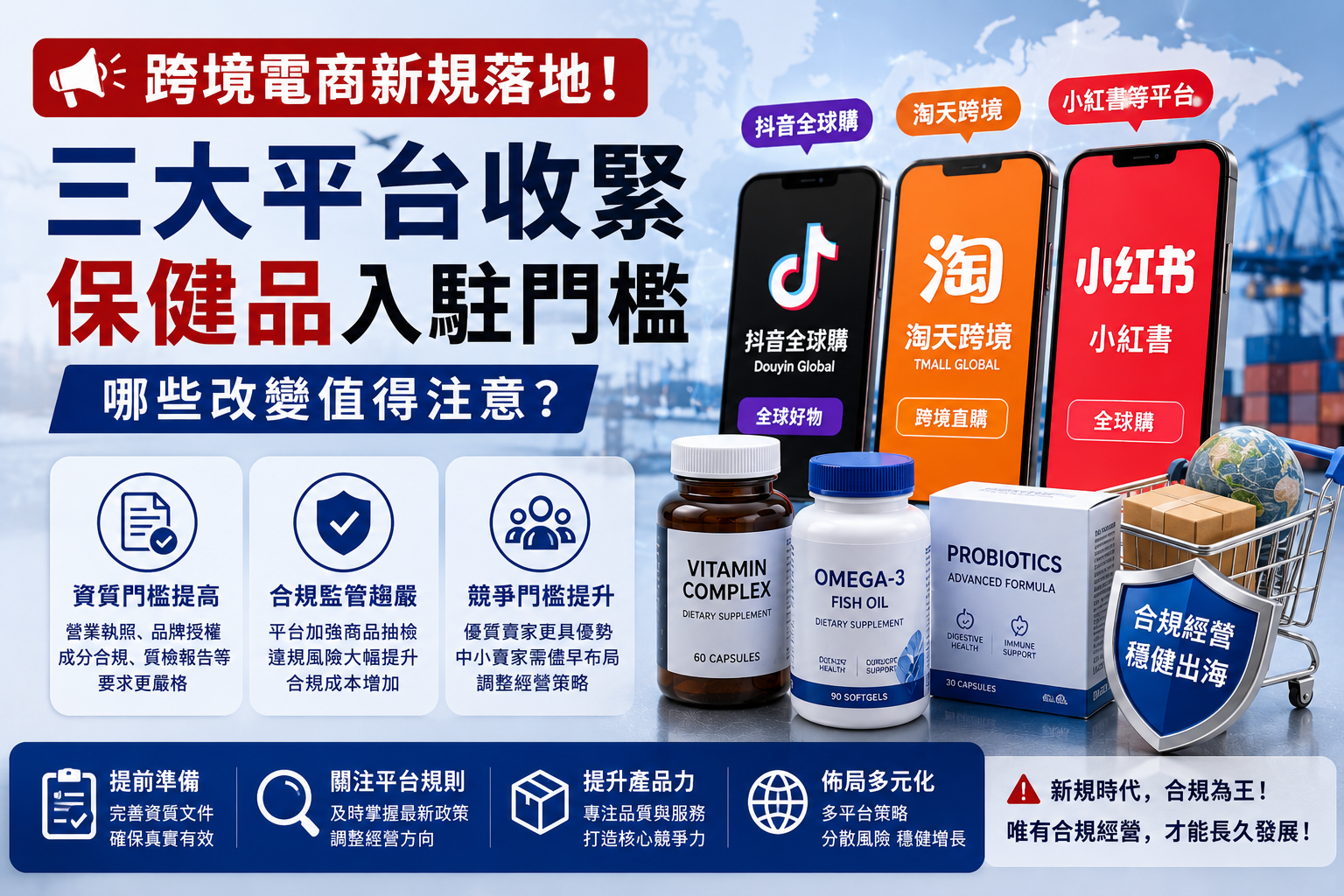
The news sent a shockwave through cross-border supplement merchant circles. Within two weeks of the summons, the major platforms rolled out new rules — onboarding review standards on Douyin Global Buy, Taobao/Tmall Cross-Border, and Xiaohongshu changed significantly, with the bar raised noticeably.
The core message was clear: platforms must shift from "formal review" to "substantive scrutiny," and from "after-the-fact handling" to "front-end prevention" — not just checking merchant qualification documents, but verifying the authenticity of the country of origin and the compliance of marketing claims. The three authorities are also pushing for "same standards, same oversight, same penalties" between cross-border and domestic goods, calling for data barriers between customs, market regulators and platforms to be broken down, a "one item, one code" full-chain traceability system to be built, and "zero tolerance" for false advertising and origin fraud.
In fact, regulatory action has been intensive throughout 2026: Customs has continued to strengthen digital, chain-based oversight of cross-border e-commerce and bonded goods; the Regulations on Hygiene and Quarantine of Special Inbound/Outbound Goods and Articles, published in January, require high-risk health products to apply for quarantine approval in advance; and Announcement No. 27 of 2026, issued in March, confirmed that 16 categories of food including health foods remain on the list of imported foods requiring officially recommended registration.
Onboarding rules for the cross-border supplement category on Douyin Global Buy have been substantially revised. New merchants must first complete an onboarding registration form, then enter a brand-vetting stage with far more detailed and stringent document requirements, mainly:
In addition, Douyin Global Buy fully implemented an "invitation-only + whitelist" system in 2026, restricting influencer-led sales and making self-broadcasting the mainstream. The Administrative Measures for Livestream E-Commerce, effective February 1, 2026, classify livestream selling as "commercial advertising"; under the Advertising Law, drugs, health foods and medical devices may not use advertising spokespersons to recommend or endorse them. Behind these rules is a precise crackdown on "fake foreign brands" and "fabricated overseas backgrounds" — the single-take offline store video exists precisely to verify a brand’s genuine overseas operations and prevent fraud using a few Photoshopped images.
Large platforms such as Taobao/Tmall Cross-Border — drawing on input from government-relations, legal and customs teams and aligning with actual customs review requirements — have explicitly tightened free-circulation documentation requirements for non-scaled brands and white-label merchants. The "five-piece set" of production documents for new merchants now includes:
Notably, some platforms previously allowed the free-circulation certificate and certificate of origin to be submitted after approval; the new rules move both to the front. This means that even supplements imported via the cross-border e-commerce model must provide complete official origin-country compliance documents at onboarding. Combined with Order No. 280 effective June 1, the entry bar for under-qualified merchants has risen sharply.
Tmall Global moved even earlier, shifting from simple "onboarding qualification review" to full-process verification of "overseas production, circulation and marketing authenticity." In February 2026, the State Administration for Market Regulation reported cases of cross-border foods penalised for failing safety indicators, with some merchants removed for being unable to provide free-sale licences or for exceeding microbial limits. For white-label and non-scaled merchants, this is unquestionably a "clear-out" compliance reckoning.
The industry is calling 2026 the "first year of compliance" for cross-border supplements. For merchants who operate compliantly, this is a survival-of-the-fittest reshuffle — and a starting point toward higher-quality growth.
ACC+ is a genuine manufacturing factory rooted in Hong Kong. Whether it is the single-take offline footage and origin/free-sale certificates required by Douyin Global Buy, or Taobao/Tmall Cross-Border’s "five-piece set" of production documents, we have real facilities, real production credentials and a complete documentation chain to back it all up — exactly what a "fake foreign brand" can never produce. From factory business registration, production agreements and certificates of origin, to free-circulation and compliant-production certificates, we handle all the certification paperwork needed for onboarding in one stop for our clients. In this "first year of compliance," partnering with a real factory that can withstand penetrating scrutiny is what lets you go further with peace of mind.