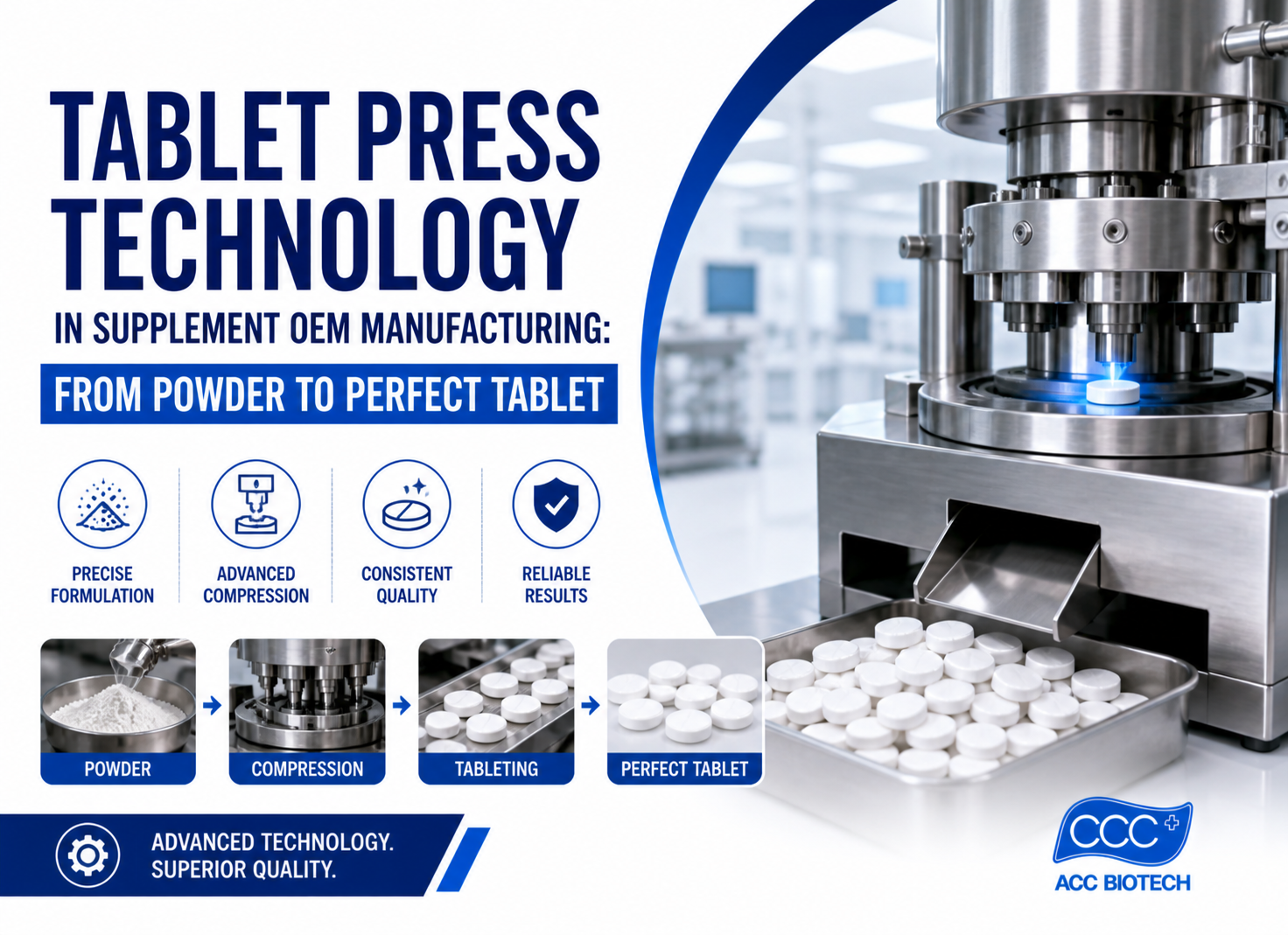
Explore modern tablet press technology used in health supplement OEM manufacturing, including rotary presses, single punch machines, and quality control systems.
Tablets remain the most common dosage form for health supplements globally, accounting for over 50% of all supplement formats. The tablet press is the heart of tablet production, transforming powder formulations into precisely dosed, uniform tablets ready for consumer use.
Suitable for R&D and small-scale production, single punch presses produce 60-200 tablets per minute. They are useful for product development, formulation testing, and very small production batches.
Standard for commercial production, rotary tablet presses can produce 5,000-100,000+ tablets per minute. Modern presses feature multiple stations (16-79 punches) for high-speed production.
For complex supplements with incompatible ingredients or controlled release properties, multi-layer presses produce two or three-layer tablets. These are ideal for combining different active ingredients in one tablet.
Weight variation must remain within tight tolerances (typically ±5%) to ensure consistent dosing. Modern presses use force feedback to maintain uniform tablet weight.
Tablet hardness affects disintegration time and durability. Hardness must be sufficient for handling but not so high as to impede dissolution.
Tablets must withstand handling without excessive chipping or breakage. Friability testing simulates stress during transportation and packaging.
Tablets must release their contents within specified time frames. Quality control includes regular disintegration and dissolution testing.
Most modern supplement tablets receive a coating, which serves multiple purposes: taste masking, protection from moisture and light, improved appearance, and easier swallowing. Film coating is the most common, applied in coating pans with precise spray systems.
ACC Biotech (www.accbiotech.com) operates multiple high-speed rotary tablet press lines, capable of producing standard tablets, multi-layer tablets, and mini-tablets. Our tablet manufacturing capabilities include integrated coating systems, advanced quality control, and high-throughput packaging. With production capacity of millions of tablets per day, we serve OEM clients of all sizes. Contact us to discuss your tablet supplement OEM project.
More from ACC Biotech: visit our international certifications, production equipment page, or contact us to discuss your project.