Explore the critical role of powder mixing and blending equipment in supplement OEM manufacturing, ensuring uniform distribution of active ingredients.
Uniform mixing of ingredients is fundamental to supplement quality. Whether producing tablets, capsules, or powder products, every dose must contain the exact specified amounts of each active ingredient. Inadequate mixing leads to dose variation, regulatory failures, and consumer safety concerns.
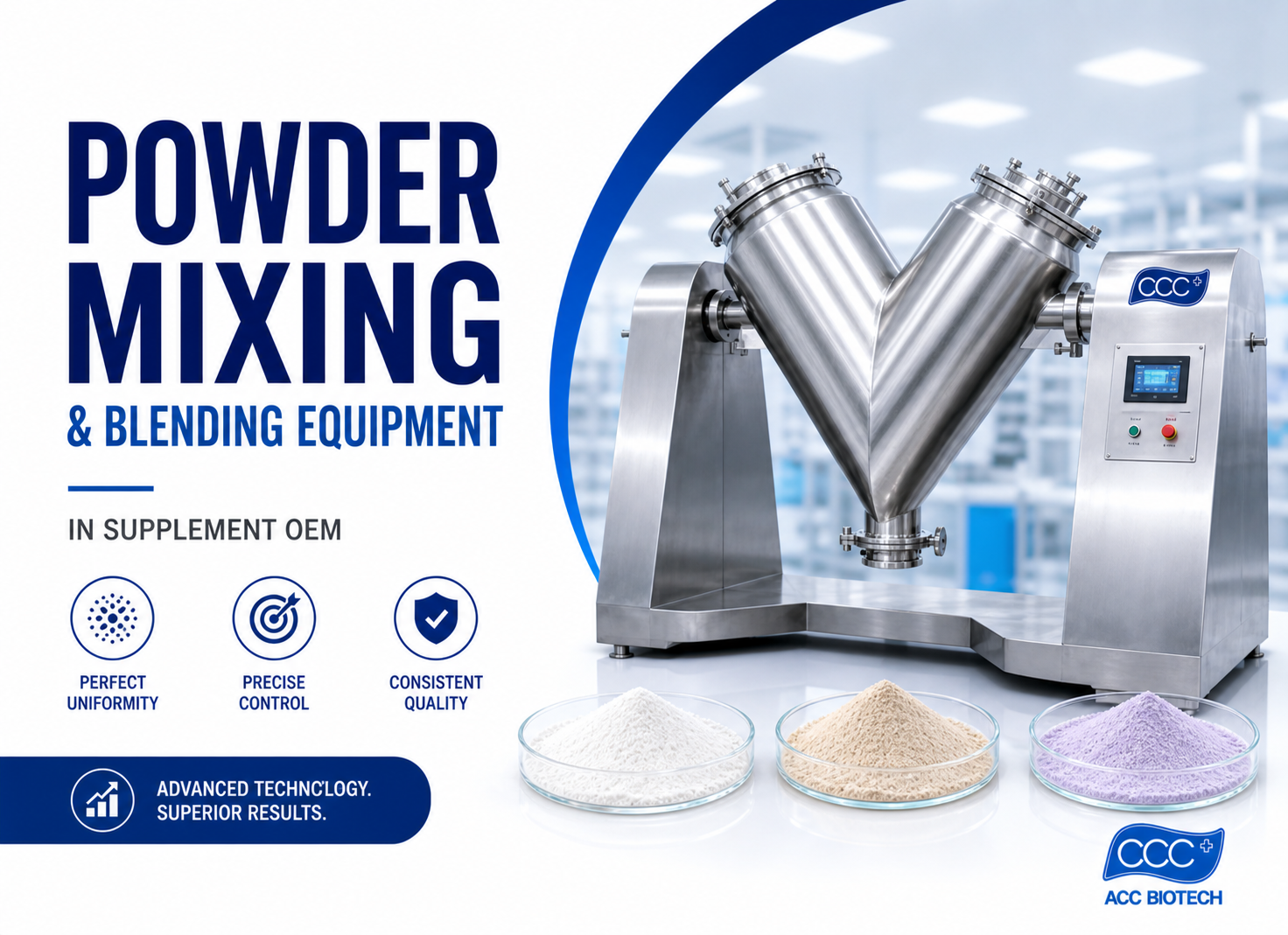
V-blenders consist of two cylindrical containers joined at an angle. The tumbling action provides gentle, effective mixing suitable for most supplement powders. Capacities range from laboratory scale to several thousand liters.
Featuring rotating spiral ribbons inside a horizontal trough, ribbon blenders are ideal for large-volume production. They efficiently combine powders of varying densities and particle sizes.
Bin blenders mix ingredients directly in transportable containers (bins or totes), reducing material handling and contamination risks. They're particularly popular for OEM facilities producing multiple products.
For formulations requiring intensive mixing, granulation, or wet mixing, high-shear mixers provide rapid, intensive mixing action. They're essential for producing certain types of granules and complex formulations.
Mixing uniformity must be validated through systematic sampling at multiple locations within the blender. Statistical analysis confirms that all samples meet specifications.
Critical parameters include mixing time, blender speed, fill volume, and order of ingredient addition. These parameters are validated and documented for each product formulation.
Mixing uniformity depends heavily on particle size compatibility. Significantly different particle sizes require special techniques like geometric dilution or pre-blending.
Between batches, mixing equipment must be thoroughly cleaned to prevent cross-contamination. Cleaning validation programs verify that residues are below acceptable limits, particularly important for allergens and potent ingredients.
Modern OEM facilities increasingly adopt advanced technologies including:
ACC Biotech (www.accbiotech.com) operates a comprehensive range of mixing equipment to handle any supplement formulation. Our facility includes V-blenders and ribbon blenders for various batch sizes, high-shear mixers for granulation, and validated mixing protocols for hundreds of formulations. Our experienced team understands the science of mixing and ensures every batch meets uniformity specifications. Contact us to discuss your supplement OEM mixing requirements.
More from ACC Biotech: visit our international certifications, production equipment page, or contact us to discuss your project.