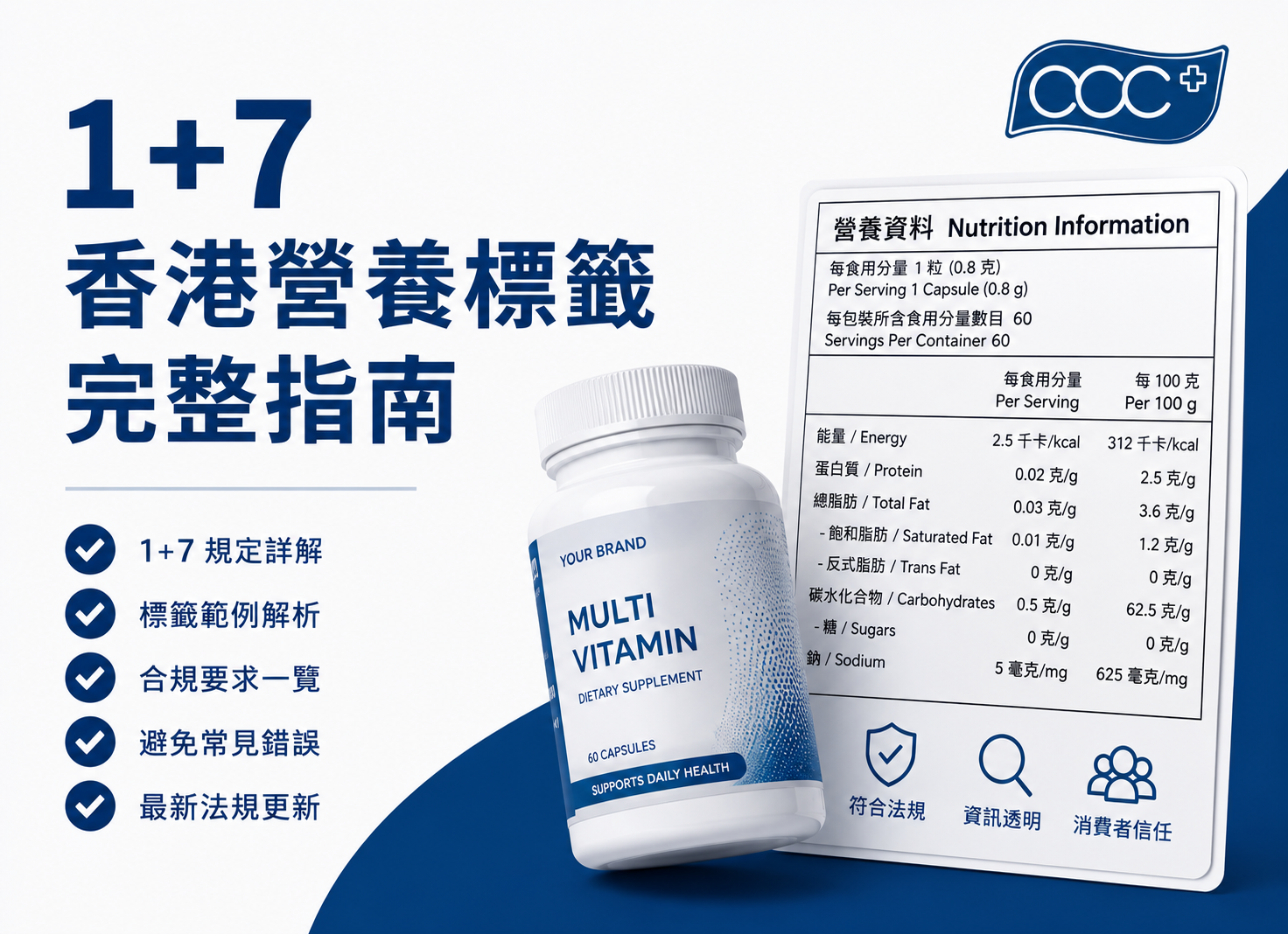
Walk down the supplement aisle of any Hong Kong pharmacy and you will see a small, dense, black-bordered box on every prepackaged product: a nutrition information panel listing energy plus seven core nutrients per 100 g or 100 mL and per serving. That box is the visible output of Hong Kong's '1+7' nutrition labelling framework — and behind it sits one of the most prescriptive labelling regimes in the region, governing format, units, tolerances, font sizes, claim consistency and enforcement.
This 2026 deep-dive guide walks through every element a supplement brand owner needs to master: the legal basis of 1+7, exactly which seven nutrients must be declared, how to calculate values from your formulation and lab assay data, the analytical tolerance bands you have to stay inside, font and layout rules, claim-versus-panel consistency, small-package exemptions, common mistakes, alignment with overseas Nutrition Facts and EU 1169 panels, and an extended FAQ. We close with how ACC+ handles 1+7 nutrition labelling end-to-end inside a Hong Kong GMP facility.
Hong Kong's 1+7 nutrition labelling rule is set out in the Food and Drugs (Composition and Labelling) Regulations (Cap. 132W) under the Public Health and Municipal Services Ordinance (Cap. 132). The Centre for Food Safety publishes Technical Guidance Notes that operationalise the law — defining what counts as a nutrition claim, what tolerances apply, what serving-size conventions are accepted, and how the panel must be laid out.
The framework applies to prepackaged food products — including most supplement formats sold to consumers — that either (a) carry a nutrition claim or (b) fall above the small-package exemption thresholds. Free samples, single-serving packs below the surface-area threshold and certain bulk catering products may be exempt. For retail supplement brands, the working assumption should be that the panel is mandatory.
The label rule is named for its structure: 1 energy declaration plus 7 core nutrients. Every prepackaged supplement subject to the rule must declare all eight items, in the prescribed order, in the prescribed units, and in two reference quantities: per 100 g or per 100 mL, and per serving as labelled.
Energy must be declared in both kilojoules (kJ) and kilocalories (kcal). The conversion factor between the two is 1 kcal ≈ 4.184 kJ, and the declared values must be mathematically consistent. Energy is calculated from the macronutrient contributors — typically protein × 4 kcal/g, carbohydrate × 4 kcal/g, fat × 9 kcal/g, with adjustments for fibre, polyols and certain other ingredients per Codex calculation conventions.
Protein — declared in grams per 100 g/mL and per serving.
Total Fat — sum of all fat constituents.
Saturated Fat — sub-total of saturated fatty acids.
Trans Fat — sub-total of trans fatty acids; declaration is required even if the value is zero, with permitted rounding conventions.
Carbohydrate — total available carbohydrate, calculated by difference or by direct analysis depending on method.
Sugar — total sugars (mono- and disaccharides).
Sodium — declared in milligrams per 100 g/mL and per serving; sometimes confused with salt, but Hong Kong uses sodium by convention.
The 1+7 panel must follow the prescribed format. Real-world flexibility is limited to colour palette, brand alignment and minor stylistic choices that do not interfere with legibility. Mandatory elements include:
A bordered table with clear column separation between per-100 g/mL and per-serving values.
Bilingual labelling in Traditional Chinese and English with equivalent prominence.
Order of items — energy first, then the seven nutrients in the order specified.
Serving size declaration — clearly stated in metric units, typically grams or millilitres, plus household measure (e.g. '1 capsule', '1 scoop (5 g)') where useful.
Servings per container — declared above or adjacent to the panel.
Energy units — both kJ and kcal.
Nutrient units — grams for macronutrients, milligrams for sodium.
Rounding conventions — small values rounded to the nearest 0.1 g; values below 0.5 g may be declared as zero with footnote conventions per the Technical Guidance Notes.
Brand owners often outsource the nutrition calculation to their OEM partner without understanding the methodology. That works until a claim is challenged. The defensible approach combines three data sources:
Each ingredient in the bill of materials contributes known nutrient values per gram. Summed across the formulation and scaled to 100 g/mL of finished product, this gives a theoretical declared value. The data source for each ingredient should be the certificate of analysis (COA) from the supplier, the China Food Composition Tables, the USDA FoodData Central, or recognised supplier nutritional data.
For high-value SKUs, products with active claims, and products approaching tolerance limits, direct laboratory analysis of the finished product is the gold standard. Standard analytical packages run on accredited HKAS or CMA-listed labs cover energy by calculation, protein by Kjeldahl, total fat by Soxhlet or acid hydrolysis, saturated and trans fat by GC, carbohydrate by difference, total sugars by HPLC, and sodium by ICP-OES or flame AAS.
Some nutrients degrade over shelf life — vitamin C and certain B vitamins are the classic examples, but trans-fat formation in stored oils and sugar Maillard losses also matter. Declared values should be set at the end of labelled shelf life, not at time of manufacture, to ensure the panel remains accurate throughout the product's market life.
Hong Kong allows defined tolerances between declared values and analytical values to account for natural variability and analytical uncertainty. As a working baseline, tolerances around ±20% apply to most nutrients, with tighter or asymmetric limits for specific categories (for example, declared values for added vitamins and minerals are commonly set to deliver no less than the labelled amount throughout shelf life). The Centre for Food Safety can analyse retail samples, and enforcement actions follow when analytical results fall outside the permitted band.
Practical implication for brand owners: do not set declared values aggressively. Use the upper end of the tolerance band only when you have analytical data supporting it; otherwise, leave headroom so that natural batch-to-batch variability does not push you out of compliance halfway through your launch.
The 1+7 panel must be legible without aids. The Technical Guidance Notes do not specify a single statutory point size; instead, x-height of approximately 1.2 mm is the practical working baseline for general products, with proportional reductions only for small-package exemptions. Other layout rules:
Contrast — black text on white, or another high-contrast combination. Reflective foils, low-contrast metallics and gradient backgrounds routinely fail inspection.
Border — the panel is enclosed in a visible border that separates it from surrounding artwork.
Position — typically on the back or side panel, not obscured by the brand name or hero imagery.
Continuity — Chinese and English values appear in the same row or in mirrored columns so the equivalence is visually obvious.
Any nutrition claim made on the package must be mathematically consistent with the 1+7 panel. The most common cause of CFS enforcement actions in this area is a claim that conflicts with the declared values.
Source of [nutrient] — typically requires at least 15% NRV per 100 g (solids) or per 100 mL (liquids) or per labelled serving.
High in [nutrient] — typically requires at least 30% NRV per the same reference.
Low in [nutrient] — applies for nutrients to be limited (fat, saturated fat, sugar, sodium); thresholds are defined per category.
Free of [nutrient] — applies for nutrients to be limited; thresholds are very low and require analytical verification.
'Reduced sugar' or 'lower in fat' claims require a clearly identified reference product, a reduction of at least 25% (with absolute minimums), and explicit declaration of the reference and the percentage on the label.
Function claims describe the physiological role of a nutrient ('calcium contributes to normal bone function'). They are tolerated when generic, supported by recognised authorities, and not specific to the branded product. They become problematic when they shade into therapeutic claims — which are prohibited under Cap. 132 and shift the product into the Cap. 138 pharmacy regime.
Serving size is not a marketing choice — it is a regulatory declaration. The serving size must reflect a reasonably anticipated amount consumed in one occasion, expressed in a metric measure (grams or millilitres) with a household measure if helpful. Setting an artificially small serving size to make per-serving nutrient values look favourable is a recognised enforcement target globally and is treated as misleading labelling in Hong Kong.
Practical guidance: align serving size with directions for use. If your label says 'take 2 capsules daily', the serving size is 2 capsules. If a liquid says 'mix 25 mL with water', the serving size is 25 mL. Document the reasoning so it survives an audit query.
Hong Kong's small-package exemption allows products with a total surface area below the prescribed threshold to use abbreviated labelling, including possible omission of the full 1+7 panel. The exemption is narrow and frequently misapplied. Single-serving sachets are not automatically exempt; the calculation is based on total surface area of the packaging, not on the size of the individual unit.
Other edge cases: products sold loose or unpackaged at retail (typically out of scope but with documentation expectations), business-to-business bulk transfers (different rules), free samples below the surface-area threshold (exempt with conditions), and online-only direct-to-consumer sales (full retail rules apply).
Mainland China's GB 28050 framework requires energy plus four core nutrients (protein, fat, carbohydrate, sodium) as the mandatory baseline, with additional nutrients required when claims are made. Format and units differ from Hong Kong; brand owners exporting both ways typically produce two separate panels rather than a hybrid.
US sales require a Supplement Facts panel under 21 CFR 101.36 — a different structure from the 1+7 framework, listing actives per serving against %DV. Brand owners exporting to the US must produce a US-specific panel; the Hong Kong 1+7 panel does not substitute.
EU sales require nutrition information under Regulation 1169/2011: energy plus six nutrients (fat, saturated fat, carbohydrate, sugars, protein, salt — note salt, not sodium, with conversion factor 2.5). Vitamins and minerals may be added voluntarily where claimed. Format differs from Hong Kong but the calculation discipline is similar.
Singapore, Malaysia, Thailand, Indonesia and the Philippines each maintain national frameworks with some AHTN harmonisation. Brand owners producing for ASEAN export should expect at minimum a country-specific overlay on the back panel.
Energy in kcal only (or kJ only) — Hong Kong requires both.
Trans fat omitted because it is zero — declaration is required even at zero, with prescribed rounding.
Serving size set unrealistically small — to make per-serving values look favourable.
Salt declared instead of sodium — Hong Kong uses sodium; EU uses salt.
Tolerances exceeded on analytical re-test — typically because values were set without stability margin.
Claim/panel inconsistency — 'low sugar' claim with 8 g sugar per serving in the panel.
Bilingual imbalance — Chinese smaller, or Chinese values rounded differently from English.
Per-100 g column missing — common when designers convert from an overseas template.
ACC+ operates a defensible 1+7 nutrition labelling workflow inside its Hong Kong GMP facility. Each new SKU is calculated from the locked formulation using validated nutrient databases, cross-verified by laboratory analysis on the first commercial batch where appropriate, and adjusted for shelf-life stability before release. The artwork team produces bilingual panels that have been reviewed by personnel trained in Hong Kong regulatory terminology. Where the brand owner also requires GB China, US Supplement Facts or EU 1169 panels, those are produced inside the same workflow with cross-market reconciliation built in.
See also our companion guides on Bilingual Safety Labelling for Hong Kong Supplements and the ACC+ One-Stop Hong Kong Supplement OEM Solution.
Every prepackaged food product, including most retail supplements, that makes a nutrition claim or exceeds the small-package exemption thresholds is required to carry a 1+7 panel. Working assumption for retail brands: the panel is mandatory.
Protein, total fat, saturated fat, trans fat, carbohydrate, sugar and sodium. Energy (the '1') is declared in both kJ and kcal alongside the seven.
Yes. Trans fat declaration is required even at zero. Permitted rounding conventions allow values below the rounding threshold to be declared as zero, but the row must still appear.
No. Serving size must reflect a reasonably anticipated amount consumed in one occasion and align with directions for use. Artificially small serving sizes are treated as misleading labelling and are an enforcement priority globally.
Tolerances around ±20% apply to most nutrients as a working baseline, with tighter or asymmetric limits in specific categories. Declared values for added vitamins and minerals are typically set so that the labelled amount is delivered throughout shelf life.
Not necessarily. Calculation-based declared values supported by ingredient COAs are acceptable for many supplements, with laboratory verification on the first commercial batch and periodic re-test. For products with active claims approaching tolerance limits, more frequent testing is prudent.
Set declared values at end of labelled shelf life, supported by accelerated and real-time stability data. For added vitamins and minerals, an overage at manufacture compensates for degradation so the labelled amount is delivered throughout shelf life.
The framework is the same. Supplements with active claims may need to declare additional nutrients beyond the core seven (for example, vitamin C or calcium content when claimed). The mandatory core remains unchanged.
No. China's GB 28050 framework is different in structure, mandatory nutrients and unit conventions. Produce a separate GB-compliant panel for China export.
Sodium. Hong Kong declares sodium directly. The EU declares salt (sodium × 2.5). When converting between markets, use the regulated conversion factor and document the calculation.
There is no single statutory point size. Legibility is the legal test; x-height of approximately 1.2 mm or above is the practical baseline for general products, with proportional reductions for small-package exemptions and the bilingual equivalence rule maintained.
With a locked formulation and ingredient COAs in hand, calculation and panel layout typically takes 3–5 working days. Where laboratory verification is required, add 5–10 working days for analytical turnaround. Multi-market panel production (HK + China + ASEAN) adds time proportional to market count.
CFS may issue a warning, require corrective labelling, detain stock, or initiate prosecution depending on severity. Brand owners should respond with batch-traceable retain analysis, root-cause investigation and a corrective and preventive action (CAPA) plan.
Yes. ACC+ produces 1+7 panels for Hong Kong plus GB nutrition panels for Mainland China, Supplement Facts panels for the US, EU 1169 panels for European export, and ASEAN-specific overlays — all inside one integrated artwork workflow with cross-market reconciliation.