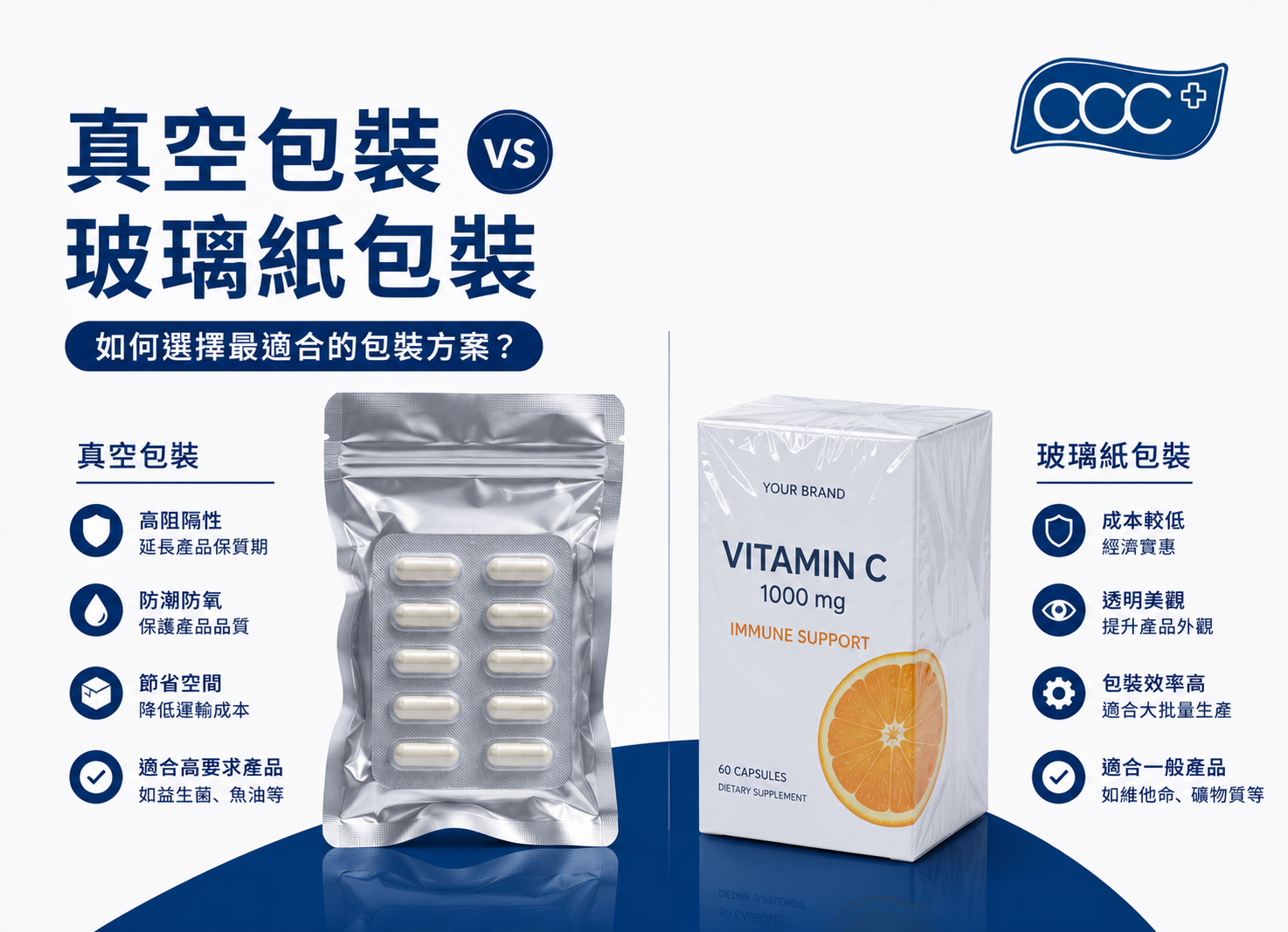
Pick up two supplement boxes from a Hong Kong pharmacy shelf and you can usually feel the difference before you read the label. One is sealed inside a taut, glass-clear film with a discreet tear-strip running across the top — that is cellophane overwrap. The other has a slightly stiffer, sometimes opaque outer layer that hugs the inner bottle with no air pockets at all — that is vacuum packaging. They look similar at first glance, but they protect product, signal brand quality and behave on a packaging line in fundamentally different ways.
This 2026 deep-dive guide compares vacuum and cellophane packaging across every dimension a Hong Kong supplement brand owner has to weigh: oxygen and moisture barrier performance, shelf-life impact, equipment and line-speed implications, unit cost, sustainability and recyclability, premium positioning and gifting suitability, regulatory considerations, and which formats (capsules, gummies, powders, liquids, herbal extracts) each option actually suits. We close with an extended FAQ and where ACC+ fits in as a Hong Kong GMP OEM partner running both technologies in-house.
Both 'vacuum' and 'cellophane' get used loosely in the trade. Before comparing them, it helps to fix what each actually means in a supplement packaging context.
True cellophane is a regenerated cellulose film, biodegradable and made from wood pulp. In contemporary supplement packaging, however, 'cellophane' is industry shorthand for any tightly heat-shrunk transparent overwrap — and the dominant material is now BOPP (biaxially oriented polypropylene), with PVC and PLA also in service. BOPP overwrap is the clear, taut film with a tamper-evident tear strip that you see on premium chocolate boxes, cosmetic sets and high-end supplement cartons.
The overwrap typically encloses the entire outer carton, not the primary bottle. It serves three purposes: tamper evidence, visual freshness signalling, and a thin secondary dust and moisture barrier. It is not a hermetic seal and it does not meaningfully extend product shelf life on its own.
Vacuum packaging removes air from the package interior before sealing, so the residual oxygen and moisture are minimised. In supplements, this most commonly appears in three formats:
Vacuum-sealed inner pouches inside a presentation box, typically used for high-value herbal extracts, ginseng, bird's nest, premium collagen powders and traditional Chinese medicine blends.
Modified-atmosphere packaging (MAP) where air is replaced with nitrogen, sometimes blended with carbon dioxide, used for sensitive actives such as probiotic blends and PUFAs.
Vacuum-overwrap presentation for premium gifting where the entire boxed product is sealed inside a vacuum-tight transparent film to protect the carton from humidity and to telegraph freshness on the retail shelf.
Vacuum packaging is a primary barrier and can materially extend product shelf life when paired with an appropriate barrier film.
The defining technical difference between the two technologies is barrier performance against oxygen and moisture — the two environmental agents that most aggressively degrade supplement actives over shelf life.
OTR measures how much oxygen passes through a film per square metre per day. Typical values for the materials at play:
BOPP cellophane-style overwrap — around 1500–2500 cc/m²/day. High, because BOPP is a low-barrier film.
PVC shrink film — around 100–300 cc/m²/day. Better than BOPP but still permeable.
Aluminised vacuum laminate (PET/Al/PE) — below 0.5 cc/m²/day. Effectively a near-total oxygen barrier.
Metallised PET vacuum film — around 1–5 cc/m²/day. Strong barrier with a softer, more flexible feel.
Vacuum packaging — when paired with an aluminised barrier laminate — provides oxygen protection roughly three orders of magnitude better than cellophane-style overwrap. For oxidation-sensitive actives like fish oil, krill oil, vitamin C, vitamin E, beta-carotene and probiotics, this is a decisive difference.
WVTR measures moisture permeation. Hong Kong's average humidity sits at 78–82% year-round, with summer extremes well above 90%, so moisture management is a critical concern for hygroscopic supplements such as collagen peptides, electrolyte powders, fibre powders and herbal extracts.
BOPP overwrap — around 5–10 g/m²/day at 38°C/90% RH. Limited barrier.
PVC shrink — around 30–50 g/m²/day. Worse than BOPP.
Aluminised vacuum laminate — below 0.1 g/m²/day. Near-total moisture barrier.
Combined with the negative pressure inside the package, vacuum packaging effectively pauses moisture-driven degradation reactions for the duration of the seal.
Vacuum laminates with aluminium foil also provide a near-complete light barrier, protecting photosensitive actives such as folic acid, vitamin K, vitamin B2 (riboflavin) and certain botanical pigments. Cellophane overwrap is transparent by design and provides essentially no light barrier on its own.
Barrier numbers translate into shelf-life numbers. While exact figures depend on formulation, primary packaging and storage conditions, indicative comparisons for common supplement categories look like this:
Fish oil softgels — bottle + induction seal + cellophane overwrap: 18–24 months. Bottle + induction seal + vacuum-foil pouch in box: 24–36 months.
Probiotic capsules — desiccated bottle + cellophane: 12 months. MAP nitrogen-flushed vacuum pouch: 18–24 months at room temperature, 24–36 months refrigerated.
Collagen peptide powders — foil sachet + cellophane outer carton: 24 months. Vacuum-sealed aluminium pouch: 24–36 months.
Premium herbal extracts and ginseng — cellophane overwrap only: 12–18 months. Vacuum-sealed presentation in lacquered box: 24–36 months.
Shelf-life claims must be supported by accelerated and real-time stability data, and the printed best-before date must be defensible against analytical re-test. Vacuum packaging is not a substitute for stability work; it is a tool that expands the achievable shelf-life envelope when stability data supports the claim.
Modern BOPP overwrap machines reach 60–120 cartons per minute, with high-end servo lines exceeding 150. The film is heat-shrunk over the carton, tamper-strip is integrated, and the format is well suited to long retail runs of identical SKUs. Changeover between cartons of similar dimensions is fast — under 30 minutes is achievable on a well-maintained line.
Vacuum lines are slower. Chamber vacuum machines typically run at 10–30 cycles per minute; continuous belt vacuum lines reach 30–60 cycles per minute; gas-flushed MAP lines are slower still because of the gas-exchange step. Vacuum laminates also require more careful sealing — heat, dwell time and pressure all need to be validated per material and per geometry, and a poor seal is catastrophic because it eliminates the entire barrier.
The throughput difference flows directly into per-unit cost. A vacuum-sealed presentation typically costs 3–5× the per-unit packaging cost of a cellophane-overwrapped carton, before considering the more expensive barrier laminate material. This is not a reason to avoid vacuum — for premium SKUs, the cost is small relative to retail price — but it is a reason to be deliberate about which SKUs deserve which technology.
BOPP overwrap — typical cost contribution of HK$0.20–0.50 per carton, dominated by film cost. The film is cheap, fast and high-margin for the packaging line.
PVC shrink — slightly lower material cost than BOPP but with sustainability and food-contact concerns that have steadily reduced its use over the past decade.
Vacuum laminate pouch (clear PET/PE) — HK$1.50–4.00 per pouch depending on size and barrier specification.
Vacuum laminate with aluminium foil — HK$2.50–6.00 per pouch for premium formats.
Nitrogen-flushed MAP — add HK$0.50–1.50 per unit for the gas and the chamber cycle time.
These ranges are indicative for medium production volumes (50,000–500,000 units per SKU) and shift with order size, geometry, print complexity and barrier specification.
Sustainability has moved from soft marketing concern to hard procurement criterion across major retail channels in Hong Kong, Mainland China and export markets. The two technologies sit very differently on this axis.
True regenerated-cellulose cellophane is biodegradable and compostable in industrial composting facilities. BOPP and PVC overwraps are not biodegradable and have inconsistent recyclability — BOPP is mechanically recyclable in regions with film recovery streams but is often landfilled where collection infrastructure is absent. PLA overwrap is industrially compostable but requires composting infrastructure to deliver on the environmental promise.
Vacuum laminates that combine plastic and aluminium are very difficult to recycle in current infrastructure — the multi-layer structure cannot easily be separated into its constituent materials. Mono-material vacuum pouches (all-PE or all-PP) are emerging and offer better recyclability but with somewhat reduced barrier performance.
For products with stability that does not require an aluminium barrier — many capsule and tablet formats — mono-material vacuum or compostable overwrap is the responsible choice. For oxidation-sensitive actives where shelf life is the customer-visible quality attribute, aluminium-laminate vacuum remains the technical answer, and the brand should communicate disposal expectations clearly to consumers.
Beyond pure technical comparison, packaging signals brand positioning at the point of sale. In Hong Kong, Greater China and most ASEAN gifting traditions, vacuum-sealed premium presentation carries strong cues of value, freshness and authenticity — particularly for ginseng, bird's nest, traditional Chinese medicine blends and high-end collagen products. Cellophane overwrap signals mass-market freshness and tamper-evidence but lacks the gravitas of vacuum.
For Chinese New Year, Mid-Autumn Festival, Lunar New Year gifting and corporate hampers, vacuum-sealed presentation in lacquered or magnetic-closure boxes is the dominant premium format. For everyday retail SKUs (vitamin C, multivitamins, sports supplements), cellophane overwrap is the appropriate fit-for-purpose choice.
Capsules and tablets — bottle with induction seal as primary; cellophane overwrap as secondary for tamper evidence and shelf appearance. Vacuum is overkill for most formulations unless actives are extremely oxidation-sensitive.
Softgels (fish oil, vitamin E, omega-3) — bottle with induction seal; consider vacuum-foil pouch inside box for premium SKUs with extended shelf-life claims.
Gummies — bottle with desiccant and induction seal; cellophane overwrap for tamper evidence; vacuum for export to high-humidity markets where moisture management is critical.
Powders (collagen, protein, fibre) — vacuum-sealed aluminium pouch is the default for medium-to-high value formulations; sachets with cellophane outer carton for portion-controlled formats.
Probiotics — MAP nitrogen-flushed vacuum is the technical answer for live-strain stability.
Herbal extracts, ginseng, bird's nest, TCM blends — vacuum-sealed presentation is the default for the category, both for technical and brand-perception reasons.
Liquid shots and tonics — primary glass or PET with foil seal; cellophane overwrap on multi-pack cartons for tamper evidence.
Both technologies sit inside Hong Kong food-contact regulation and international equivalents. Films and laminates used for direct or indirect supplement contact should be certified to FDA 21 CFR food-contact rules and/or EU Regulation 10/2011 on plastics in contact with food. Migration testing is part of the supplier qualification dossier, particularly for products with high fat content (fish oil, MCT-based formulations) where migration risk is elevated.
PVC overwrap has come under sustained regulatory pressure in the EU and is increasingly avoided in supplement export packaging despite remaining permitted for many uses. BOPP and PLA face no equivalent restrictions and are the safer specification choices for brands building artwork for multiple export markets.
ACC+ operates both cellophane overwrap and vacuum packaging inside its Hong Kong GMP facility. The integrated capability covers BOPP shrink-film overwrap with tamper-evident strips, vacuum-sealed inner pouches with aluminium-laminate barrier film for premium SKUs, MAP nitrogen-flushed packaging for probiotics and PUFAs, and full presentation packaging (lacquered boxes, magnetic-closure gift boxes, ribbon-tied cartons) for Chinese New Year and corporate gifting programmes. Because formulation, filling, sealing and packaging share a single quality system, batch traceability, artwork management and stability data all flow inside one master batch record. See also our companion guides on Supplement Bottling, Liquid Filling and Labelling and the ACC+ One-Stop Hong Kong Supplement OEM Solution.
No. Vacuum provides far higher oxygen and moisture barrier, which is decisive for oxidation-sensitive actives and humidity-sensitive powders. For shelf-stable capsule and tablet formulations, cellophane overwrap is technically adequate and significantly more economical.
For oxidation-sensitive formulations such as fish oil, vitamin C and probiotics, a properly specified vacuum-foil package can extend shelf life by 6–18 months over a non-vacuum equivalent. The exact extension depends on formulation, primary packaging and stability data.
In industry usage, yes — 'cellophane' is now shorthand for any heat-shrunk transparent overwrap. Strictly speaking, true cellophane is regenerated cellulose. Most contemporary supplement overwrap is BOPP, with PVC and PLA also in service.
Pure-plastic mono-material vacuum pouches are recyclable in regions with film-recovery infrastructure. Aluminium-laminate vacuum pouches are very difficult to recycle and typically end up in landfill or energy recovery. Mono-material vacuum laminates with adequate barrier performance are an active area of supplier development.
Modified-atmosphere packaging (MAP) replaces the air inside the package with an inert gas — typically nitrogen, sometimes blended with carbon dioxide — before sealing. It is used for sensitive actives such as probiotic strains, PUFAs, and certain botanical extracts where oxygen is the primary degradation driver.
BOPP cellophane overwrap typically contributes HK$0.20–0.50 per carton at medium production volumes, dominated by film cost. PVC shrink is similar; PLA biodegradable overwrap is two to three times more expensive.
Yes. BOPP and PLA accept high-quality flexographic and rotogravure printing. Printed overwrap is common for promotional SKUs and limited-edition gifting variants. Printing adds to material cost and lead time.
Not always. Many supplement formats are adequately protected by primary packaging (bottle with induction seal and desiccant) alone. Vacuum becomes valuable when the formulation is hygroscopic, the export market has extreme humidity, or the brand is positioned at the premium tier where extended shelf life is part of the value proposition.
Vacuum lines run economically from a few thousand units per SKU; smaller pilot runs are achievable but with proportionally higher per-unit cost. MOQ at ACC+ varies by format — contact us for a specific quotation.
Yes. Vacuum-sealed inner pouches inside lacquered or magnetic-closure presentation boxes is one of our standard premium configurations, particularly for Chinese New Year gifting, corporate hampers and traditional Chinese medicine product lines. We handle artwork, pouch sealing, box assembly, ribbon and seal application end-to-end.
Yes, when applied with an integrated tear strip that cannot be reapplied after opening. Heat-shrunk overwrap without a tear strip provides visual tamper evidence but is not as defensible against sophisticated tampering.
Start from formulation sensitivity (oxidation, moisture, light), then layer on shelf-life requirements, retail-channel expectations and brand positioning. For a quick decision: oxidation-sensitive actives or premium gifting positioning → vacuum; shelf-stable everyday retail → cellophane. ACC+ runs both technologies and can advise on the optimal configuration for a given SKU during formulation lock.