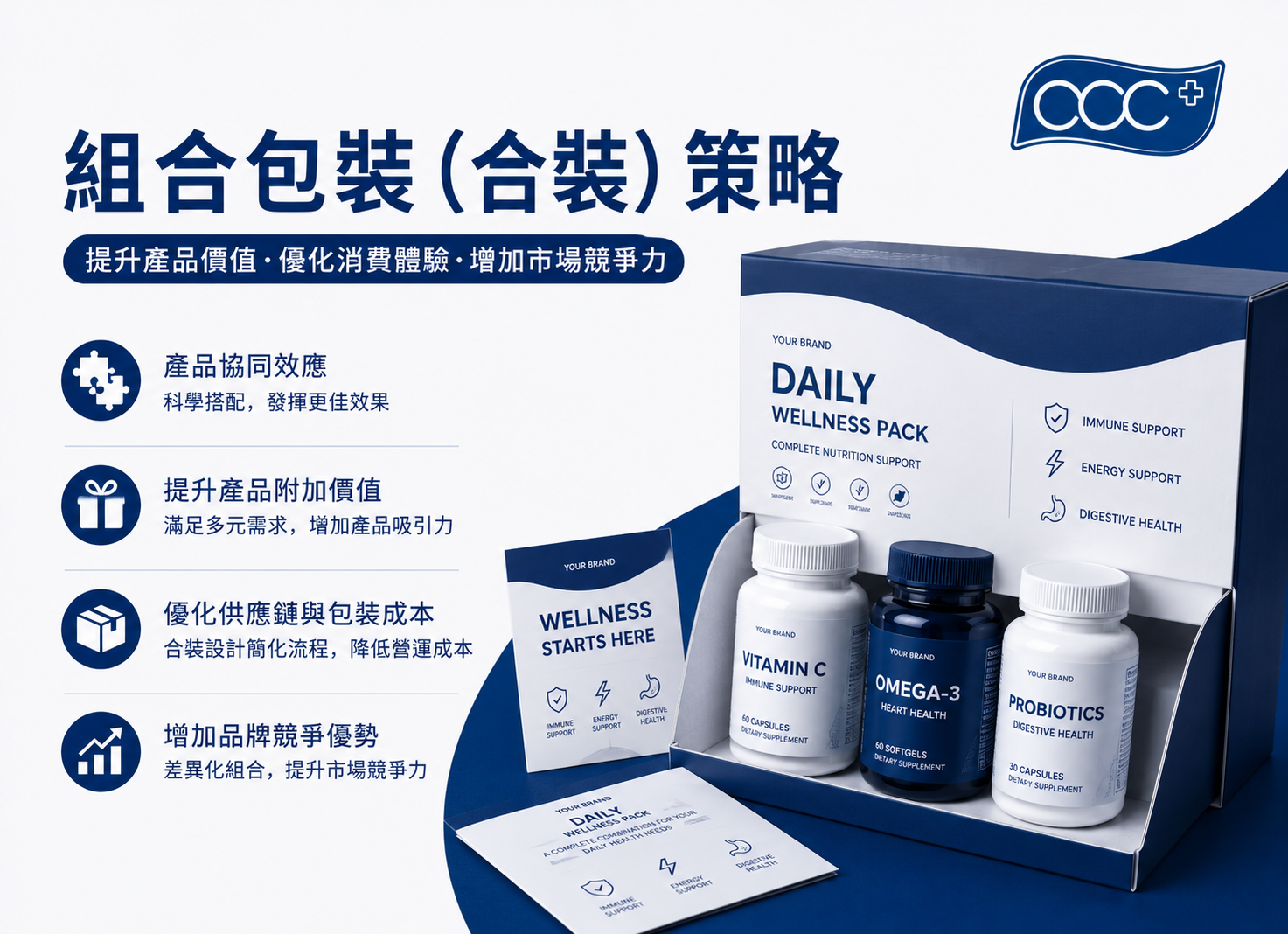
Combo packaging — bundling two or more SKUs into a single gift set, festival edition, trial pack or family bundle — is one of the most effective levers for raising average order value (AOV) in Hong Kong's supplement market. Executed well, a combo pack increases revenue per transaction by 30–60%, clears slower-moving SKUs, aligns with seasonal peaks (Chinese New Year, Mid-Autumn, Christmas, Mother's / Father's Day) and adds a gifting ritual that pure single-unit SKUs cannot replicate.
Executed badly, however, combo packaging quietly destroys margin: mismatched expiry dates force write-offs, an outer box that fails Hong Kong's 1+7 nutrition label or bilingual safety rules triggers a relabelling exercise, and unclear net-weight aggregation leads to customs rejections at the destination. This guide explains the four main combo formats, the commercial logic behind each, the three biggest design pitfalls, MOQ and pricing considerations, and how a one-stop OEM such as ACC+ executes combo packaging end-to-end.
Not all combos serve the same goal. Picking the right format starts with knowing what each one is designed to do.
Two to four hero SKUs presented inside a structurally engineered outer box, often with foil printing, magnetic closures or window cut-outs. The goal is gifting — Mother's Day, Father's Day, Chinese New Year hampers, corporate year-end gifts. Average price point is significantly higher than the sum of individual SKUs.
Smaller-format versions of multiple SKUs sold as a "starter pack" or "discover set" at a price below the sum of individual full-size units. The goal is acquisition — getting first-time buyers to experience the brand across categories rather than committing to one full-size SKU.
Combinations designed around household segmentation: adult + child, male + female, parent + grandparent. Marketing aligns with family rituals — "back to school", "Lunar New Year reunion", "elderly health month". Family packs often carry the highest re-purchase rate of any combo format.
Collaboration combos with complementary brands (skincare, F&B, lifestyle), or seasonal limited editions tied to a campaign. These work best when the combo is genuinely thematic rather than a forced co-branding exercise.
From a commercial perspective, combo packaging works on four mechanisms simultaneously:
Most combo projects that fail commercially fail for one of three predictable reasons.
When SKUs inside a combo have different shelf lives, the outer pack is governed by the earliest expiry date inside. Combining a 36-month vitamin with a 12-month probiotic forces the entire combo to be sold within the probiotic window. Without rigorous FEFO discipline, write-offs are inevitable.
The outer box of a combo is itself a regulated label. Hong Kong's 1+7 nutrition labelling, bilingual safety warnings and ingredient declarations must appear on the outer box — not just on the inner SKUs. Combos destined for export markets must additionally satisfy that market's labelling rules (EU, US FDA, NMPA, ASEAN, Halal).
Customs and retail systems often classify combos by aggregated net weight or content count, not by individual SKU. Mis-declared totals trigger customs holds, retailer barcode rejections or e-commerce listing failures. Net-weight calculations must be documented and verified before printing.
Combo packaging usually carries a higher per-unit packaging cost than single SKUs because of outer-box tooling, manual or semi-automated pack-out, and additional QC steps. Brand owners should expect:
ACC+ runs combo packaging end-to-end inside its Hong Kong facility: concept planning, structural design, outer-box sourcing, raw-material and inner-SKU production under GMP, label-compliance review, pack-out and outbound logistics. Because filling and combo pack-out happen on the same site, lead time compresses significantly and label revisions can be applied in one cycle rather than coordinated across multiple vendors. See also ACC+ One-Stop Hong Kong Supplement OEM Solution and Supplement OEM MOQ & Pricing Guide.
Combo packaging bundles two or more supplement SKUs into a single retail unit — usually a gift set, festival edition, trial pack or family pack — under one outer box and one combined barcode.
In Hong Kong's supplement market, well-designed combos typically lift AOV by 30–60% per transaction, depending on the price gap between the combo and the sum of individual SKUs and the strength of the gifting narrative.
The earliest expiry date among the SKUs inside the combo governs the outer pack. This is critical when combining long-shelf-life vitamins with shorter-shelf-life products such as probiotics.
Yes. In Hong Kong, the outer box is itself a regulated label and must carry compliant 1+7 nutrition labelling, bilingual safety warnings and ingredient declarations consistent with the inner SKUs.
Combos are often classified by aggregated content count or net weight. Mis-declared totals can trigger customs holds, retailer barcode rejections or e-commerce listing failures, so totals should be documented and verified before printing.
Book at least two to three months before each gifting peak — Chinese New Year, Mid-Autumn, Christmas, Mother's / Father's Day — to allow for outer-box tooling, label compliance review and combo pack-out.
Pure co-packers can pack-out combos using SKUs supplied by the brand, but they typically don't handle structural design, outer-box label compliance or export documentation. A one-stop OEM such as ACC+ covers the full chain.
Yes. Multi-SKU samplers and trial bundles are highly effective for acquiring first-time buyers, particularly in DTC and cross-border e-commerce, where consumers want to experience a brand across categories before committing to full-size SKUs.