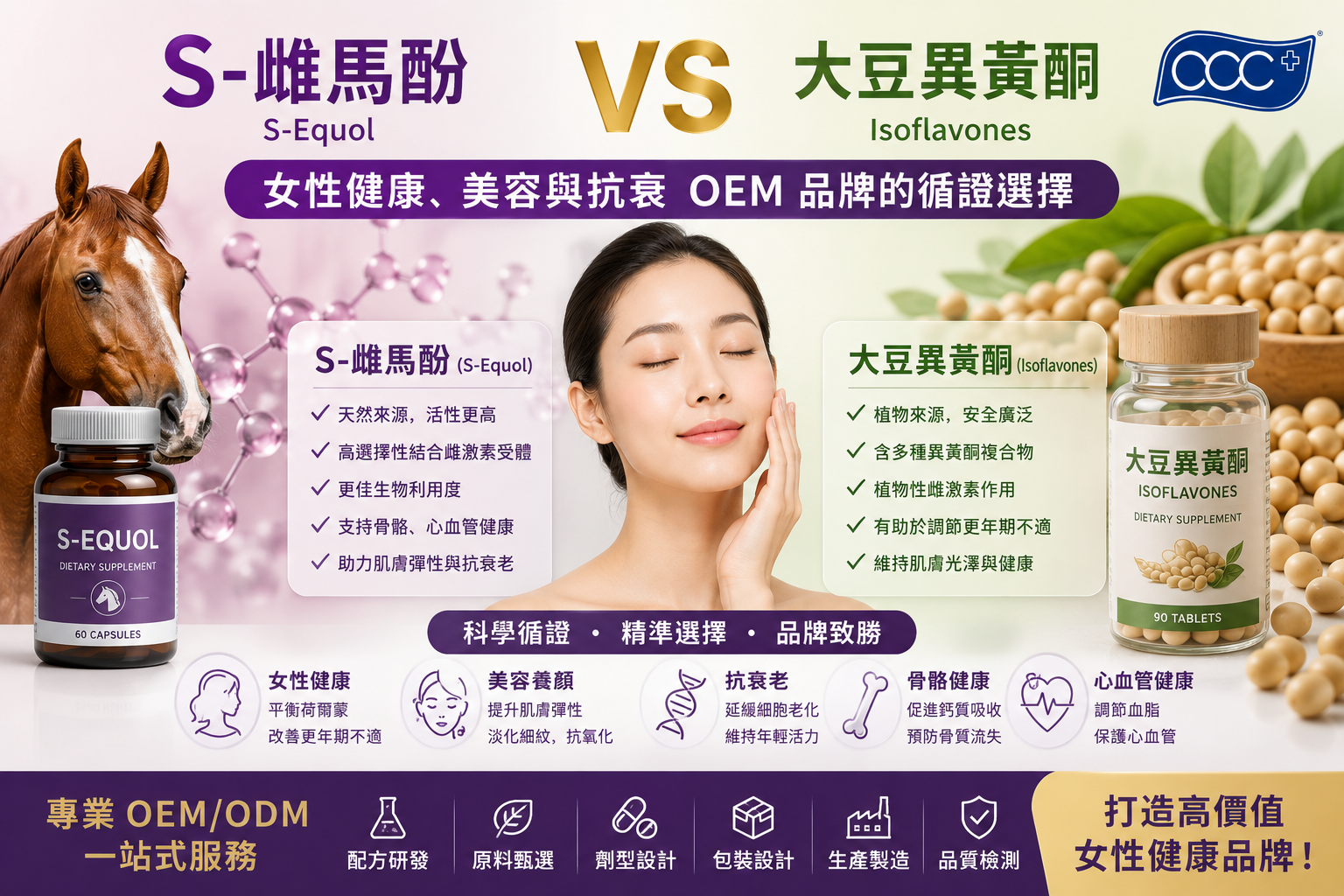
Walk into any Hong Kong pharmacy and you will see two shelves stacked with women's health supplements: one full of traditional soy isoflavone capsules, and a newer, premium-positioned shelf featuring S-Equol. The price gap is often three- to five-fold. From a marketing distance, both products promise the same thing — menopause support, bone health, skin elasticity. So why does the science increasingly side with S-Equol, and why are sophisticated OEM brand owners across Greater China quietly shifting their next product launches in that direction?
This article unpacks the biology, the clinical evidence, the consumer segmentation logic, and the formulation architecture brand owners should consider when deciding between a soy isoflavone SKU, an S-Equol SKU, or a combined ingredient story.
Soybeans contain three main isoflavones — daidzein, genistein and glycitein. Of these, daidzein is the precursor that the human gut microbiome may convert into equol. Crucially, the responsible enzymes are found only in specific bacterial species, and not every human carries them. Population studies consistently show that around 50% of East Asian adults and only 20–30% of Western adults are 'equol producers'. The remaining majority can swallow soy isoflavone capsules daily for years and never generate meaningful systemic equol levels. For them, a soy isoflavone SKU is simply not delivering the most clinically active metabolite.
S-Equol bypasses this lottery. By supplying the metabolite directly, every consumer — equol producer or not — receives the same active dose, the same receptor engagement, and the same outcome reliability. From a brand owner's perspective, this is also a product story consumers can intuitively understand: 'Half of you cannot make this from soy. We give it to you ready-made.'
S-Equol binds preferentially to estrogen receptor beta (ERβ), which is enriched in bone, brain, vascular endothelium and skin. Its affinity for estrogen receptor alpha (ERα), which dominates breast and uterine tissue, is considerably lower. This selective profile is the scientific basis for the favourable safety story that distinguishes S-Equol from both bioidentical hormone therapy and from broad-spectrum phytoestrogens. For consumers who are anxious about hormone-related risks but still want meaningful relief from perimenopausal symptoms, this is a powerful differentiator. The key word in your label and marketing copy is 'selective', not 'estrogenic'.
S-Equol has accumulated a respectable body of randomised, placebo-controlled clinical work, predominantly from Japanese and US research groups. Without making medical claims, the evidence base for OEM brand positioning includes the following indication areas:
Brand owners should always work with their regulatory consultant to align label claims with local rules — Hong Kong, Mainland China, Singapore, Vietnam and the EU each draw the medical-claim line in a different place. The point here is that the underlying evidence base is broad enough to support multiple distinct consumer stories from the same active ingredient.
In our experience working with OEM brand owners across Hong Kong and Greater China, S-Equol typically anchors one of four distinct product stories. Picking the right story up front determines packaging, dose tier, secondary actives and channel strategy.
Positioning: gentle daily support through the transition. Dose: 10 mg S-Equol. Synergistic actives: black cohosh extract, vitamin D3, magnesium glycinate. Channel: pharmacy chains, women's health clinics, gynaecology referral.
Positioning: skin elasticity, fine line visibility, hair density. Dose: 10–30 mg S-Equol. Synergistic actives: marine collagen peptides, hyaluronic acid, vitamin C, astaxanthin. Channel: cosmetic counters, online direct-to-consumer, beauty KOL collaborations.
Positioning: bone density, joint comfort, postmenopausal vitality. Dose: 10 mg S-Equol. Synergistic actives: calcium, vitamin D3, vitamin K2 MK-7, magnesium. Channel: senior health, clinical nutrition, traditional retail.
Positioning: science-led healthy ageing, ERβ-selective phytoestrogen, NAD+ partnership. Dose: 10 mg S-Equol. Synergistic actives: NMN, resveratrol, spermidine, coenzyme Q10. Channel: premium online, longevity clinics, executive health programmes.
For the latest read on what ingredients are commercially moving in 2026, see our overview of Hong Kong Supplement OEM 2026 Trending Ingredients.
This is one of the most frequent formulation questions we receive. The short answer: yes, and there is a defensible rationale for doing so. Soy isoflavone extract (typically 40% total isoflavones, with daidzein, genistein and glycitein) brings additional non-equol bioactivity — particularly from genistein, which has its own receptor and tyrosine-kinase-related activity. Layering a moderate dose of soy isoflavones (50–100 mg of total isoflavones) on top of a 10 mg S-Equol active gives consumers the combined benefit of both, while still allowing the brand to use the 'S-Equol' name as the headline ingredient. The downside is unit cost and capsule size — at higher doses, two capsules per day become necessary.
A workable 10 mg S-Equol capsule contains roughly 12–15 mg of pure API (allowing for overage and analytical variability), surrounded by carefully selected excipients to ensure flowability, dissolution and stability. A typical fill weight is 350–450 mg for a size 1 capsule. Key formulation considerations include:
For a complete walk-through of how a formulated capsule moves through filling, weighing and packaging, see Capsule Filling Machine Technology in Supplement OEM.
S-Equol sits in the premium segment of the supplement market, where consumers expect — and pay for — credible provenance. Hong Kong manufacturing supplies precisely the credentials that a premium positioning requires:
For the full breakdown of why Hong Kong consistently outperforms generic offshore manufacturing for premium positioning, see Why Choose Hong Kong Supplement OEM in 2026.
Generally no, because the price point and consumer segment are different. A typical soy isoflavone SKU retails at HKD 200–400 for a 60-day supply; an S-Equol SKU at HKD 600–1,200. Brands that carry both tend to position them as 'entry' and 'premium' tiers within the same therapeutic franchise.
S-Equol's receptor-selective profile is exactly why this question keeps coming up. Brand owners must direct such consumers to consult a qualified healthcare professional, and must avoid making any therapeutic claims on the label. The honest answer is that the published evidence is reassuring relative to broader phytoestrogens, but every individual case is different.
Some published work has looked at prostate health markers in men. This is a smaller and more nascent segment, but it is a credible white-space opportunity for brands willing to develop a male-targeted SKU.
Start-up brands typically launch from 3,000–5,000 bottles per SKU, which equates to roughly 1–2 kg of API for a 10 mg daily dose. Larger commitments unlock better API tier pricing.
Yes. We provide an indexed bibliography of the published clinical work on S-Equol that brand owners can hand to their regulatory and marketing teams as a starting point for claim substantiation.
Soy isoflavones built the women's health category. S-Equol is what allows that category to grow into a premium, evidence-led, globally credible product story. For brand owners willing to invest in the right raw material and the right manufacturing origin, S-Equol is one of the few ingredient launches where the science and the consumer narrative are perfectly aligned.
If you are ready to scope your S-Equol launch — single SKU or full product family — contact our team, and we will return with target spec, MOQ, lead time and a draft formulation matched to your chosen consumer story.