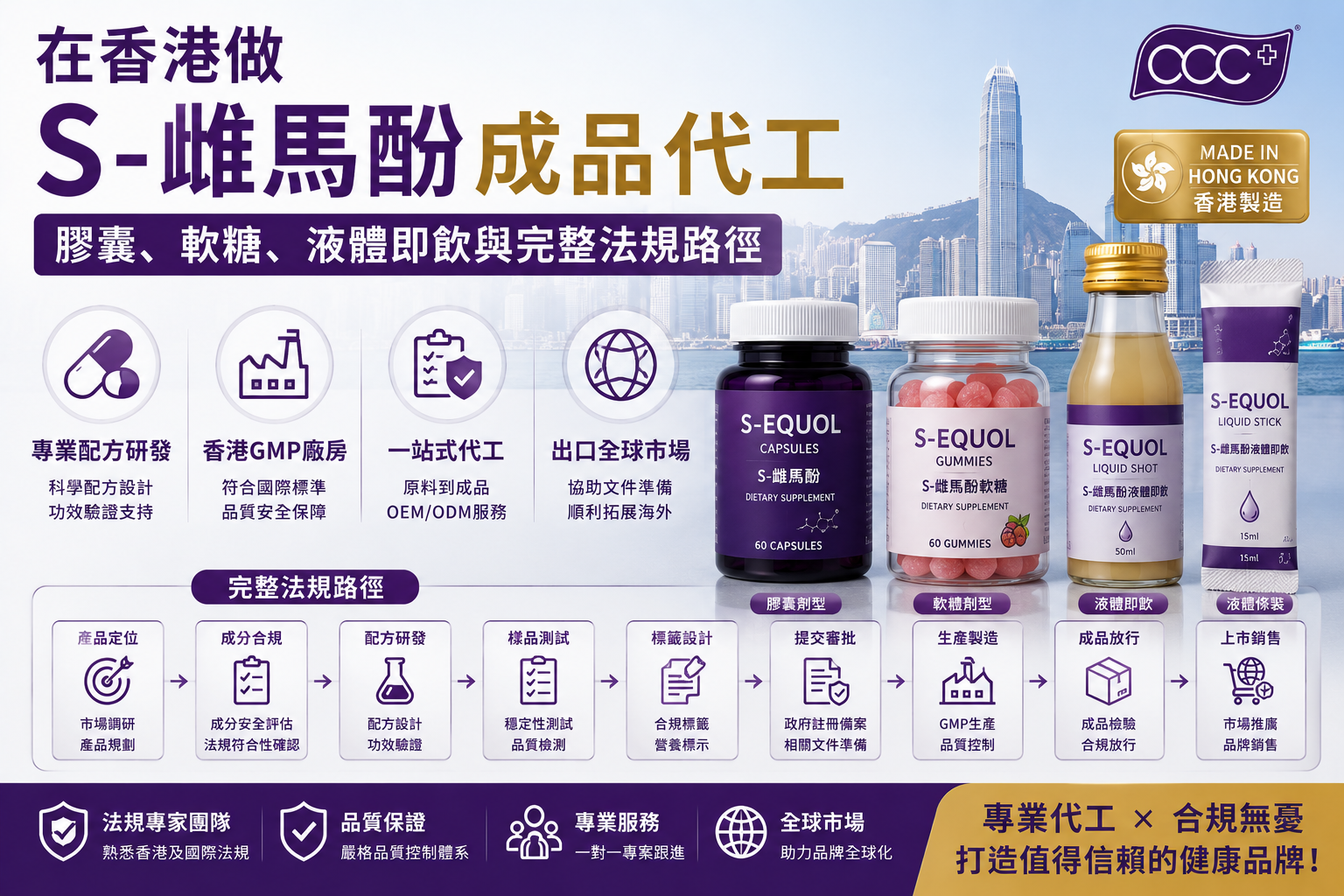
Choosing S-Equol as your hero ingredient is the comparatively easy part. The harder, more interesting work begins when you sit down with your contract manufacturer to decide how the molecule should reach the consumer's hand — capsule, gummy, liquid shot or stick pack — and how the finished product will satisfy the regulatory expectations of the markets you actually intend to sell into. This article is a hands-on playbook for that conversation, written from the perspective of a Hong Kong OEM partner who has put S-Equol products onto shelves across Hong Kong, the Mainland, ASEAN and the GCC.
The same 10 mg of S-Equol can land very differently depending on how it is delivered. Each format carries its own cost, claim potential, channel suitability and shelf-life realities. Below is the working matrix we share with brand owners during the discovery phase.
Best for: classic women's health and bone-health positioning. Dose per unit: 5, 10 or 30 mg. Cost index (1 = lowest): 1. Shelf life: 24 months. Pros: simple, stable, easy to combine with multi-actives, suited to pharmacy and clinical channels. Cons: less giftable, less differentiated visually.
Best for: oil-soluble co-actives (omega-3, astaxanthin, vitamin E). Dose per unit: 10 mg. Cost index: 1.6. Shelf life: 24 months. Pros: premium feel, easy to swallow. Cons: S-Equol itself is not oil-soluble, so it is encapsulated in a suspension matrix — formulation complexity is higher.
Best for: beauty-from-within and consumer-direct online positioning. Dose per unit: typically 5 mg (so two gummies per day). Cost index: 2.2. Shelf life: 12–18 months. Pros: highest engagement, premium price tolerance, strong social media presence. Cons: water activity must be tightly controlled to prevent degradation; sugar profile must be managed (we recommend sugar-reduced or sugar-free with allulose / erythritol).
Best for: high-tier menopause / longevity positioning, often combined with collagen peptides or NMN. Dose per unit: 10 mg in 25–50 ml. Cost index: 2.8. Shelf life: 9–12 months. Pros: premium retail price, strong perceived efficacy, gift potential. Cons: shortest shelf life; needs amber or opaque packaging and aseptic filling.
Best for: travel-friendly daily ritual products. Dose per unit: 10 mg. Cost index: 1.8. Shelf life: 18 months. Pros: light and portable, novel format for the category. Cons: hygroscopic — needs individually foil-wrapped tablets, which adds cost.
If you want to go deeper on each format's manufacturing line, equipment and capability, see our walkthroughs on supplement bottling, filling and labelling automation, powder mixing and blending equipment, and softgel manufacturing process.
S-Equol products tend to sell across multiple jurisdictions simultaneously — Hong Kong, Mainland China, Singapore, Malaysia, Vietnam, and increasingly the UAE. Each market draws the line between a 'general supplement' claim and a 'medicinal' claim in a different place. The safest design philosophy is to build one master label that satisfies the strictest requirement, then localise where needed.
Supplements are regulated as food unless they cross the line into pharmaceutical claims. Bilingual (English + Traditional Chinese) ingredient list, allergen statement and nutrition information must be present. The Centre for Food Safety's 1+7 nutrition labelling scheme applies once health-related representations are made.
For a full walkthrough, see our Hong Kong 1+7 Nutrition Label Guide and Bilingual Safety Labelling for Hong Kong Supplements.
Two routes exist. The cross-border e-commerce (CBEC) route allows imported supplements to reach Mainland consumers without full domestic registration, provided the product appears on the positive list and is sold through bonded warehouse channels. The general trade route requires either a 'blue hat' health-food registration (the slow, expensive path for products making approved health functions claims) or a notification filing for vitamin/mineral products. S-Equol is most commonly launched first through CBEC, then escalated to general trade if volumes justify the registration investment.
Singapore (HSA), Malaysia (NPRA), Vietnam (MoH) and Indonesia (BPOM) each require a notification or registration dossier. The Hong Kong FSC and COO meaningfully accelerate these processes. Halal certification is usually a deal-breaker for the Malaysia and Indonesia channels — S-Equol made through soy fermentation in an HPMC capsule is intrinsically vegan and can be certified halal without difficulty.
The UAE and Saudi Arabia accept Hong Kong-issued FSC as a baseline registration document. EU markets require a Novel Food assessment for S-Equol if it has not been used in significant food quantities before May 1997 — this is a more involved pathway and most brands target the EU only after they have established Greater China and ASEAN volumes.
S-Equol's clinical evidence is genuinely strong, which makes it tempting for marketing teams to over-claim. Resist that temptation. The claims that are well supported and safely worded for general supplement positioning include:
Claims to avoid in supplement labelling include any reference to treating, preventing or curing menopause, osteoporosis, breast cancer or any other disease state. These claims push your product into the pharmaceutical category in every jurisdiction we work with and will cause registration to fail.
A typical S-Equol OEM project at our Hong Kong facility runs as follows:
Indicative MOQ for a first-launch SKU is 3,000–5,000 bottles for capsules and softgels, 5,000–10,000 bottles for gummies (driven by depositor line economics), and 10,000 units for liquid shots. These MOQs are flex-down compared to most regional competitors precisely because Hong Kong-based contract manufacturers serve a high mix of start-up brands.
For a complete cost-line breakdown of an OEM project, see our Hong Kong Supplement OEM Cost Breakdown, and for new-brand sequencing, see the Hong Kong Supplement OEM Startup Brand Roadmap.
Three documents do most of the export heavy lifting for an S-Equol brand manufactured in Hong Kong:
These three documents are at the heart of our standard delivery package — see Hong Kong Supplement OEM: ACC+ One-Stop Solution from Our Own Factory for the full mechanics.
Because S-Equol sits at a high price point, the per-batch QC burden is substantial — and worth it. Our standard batch release for S-Equol products includes:
Our laboratory and QC capability is documented in Quality Control Testing in Supplement OEM.
Yes — and we strongly recommend it. Start with a hard capsule for the lowest cost, fastest time to market and broadest channel acceptance. Once the brand has retail traction, layer on a gummy for D2C and a liquid shot for premium retail. The capsule formula serves as the anchor SKU and absorbs the bulk of API volume commitment.
3,000 bottles of a 60-capsule HPMC capsule SKU at 10 mg per capsule — that is roughly 1.8 kg of API, plus packaging and QC. We routinely take projects at this scale.
Yes, and it is usually the right first step. CBEC avoids the long blue-hat registration timeline while still giving the brand legitimate access to Mainland consumers. We can prepare the full CBEC documentation pack as part of the OEM service.
Realistically 12–16 weeks from first call to product on shelf, assuming the formula is reasonably standard. Highly novel formulations or new packaging tooling can extend this to 18–20 weeks.
Yes. Under our OBM (Original Brand Manufacturing) model, we accompany start-up founders from positioning through formulation, packaging design, regulatory dossier, manufacturing and dispatch. This is the path most first-time supplement brand owners take with us.
Formulating an S-Equol product is where the molecule meets the market. The right dosage form unlocks the right consumer, the right label opens the right shelf, and the right manufacturing origin sustains the premium price point that makes the entire economics work. None of those choices have to be made alone.
If you would like to discuss your S-Equol launch — across any dosage form, any target market and any brand stage — contact our team. We will return with a complete proposal: formula, MOQ, lead time, regulatory pathway and a full Hong Kong document package.