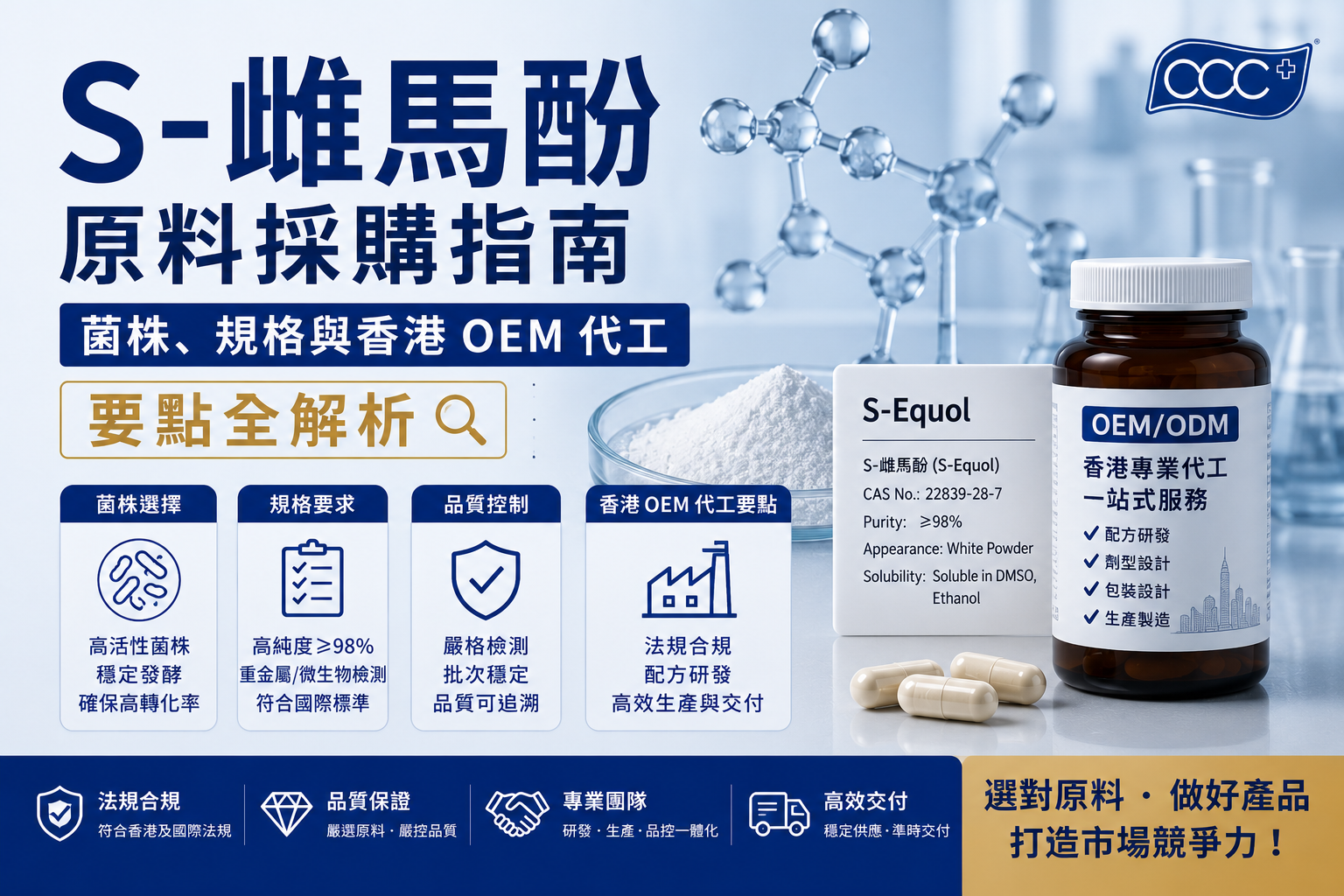
S-Equol — chemically known as (S)-4',7-isoflavandiol — is one of the most clinically interesting molecules to emerge from soy isoflavone research in the last two decades. Unlike daidzein or genistein, which are consumed directly through soybeans, S-Equol is produced inside the human gut when specific bacteria convert dietary daidzein. The problem? Only roughly 20–30% of Western populations and around 50% of East Asian populations carry the gut flora capable of producing it. For OEM supplement brands targeting women's health, menopause, beauty-from-within or healthy-aging markets, supplementing S-Equol directly removes that biological lottery — but it also raises a long list of raw-material questions that brand owners often underestimate.
This article walks through what every brand owner should ask before placing an S-Equol OEM order: the production route, the fermentation strains involved, the specification sheet that actually matters, stability and packaging considerations, MOQ economics, and how a Hong Kong-based contract manufacturer can package all of this into a market-ready finished product.
Equol exists as two enantiomers: S-equol and R-equol. Only the S-form is produced by human gut bacteria, and only the S-form binds with high selective affinity to estrogen receptor beta (ERβ) — the receptor associated with bone, brain and cardiovascular tissues, with comparatively low binding to ERα (which dominates breast and uterine tissues). This receptor selectivity is what gives S-Equol its favourable safety profile in published clinical work and is precisely why a racemic (50:50) equol mixture or an R-enriched material is not a substitute. When you source S-Equol, the certificate of analysis (CoA) must specify enantiomeric purity, not just total equol content.
There are three commercially viable routes to S-Equol, and they produce materials with very different properties, price points and regulatory stories.
This is the route used by the most established suppliers. Daidzein, extracted from soybean germ, is fed to an equol-producing bacterial strain — most famously Lactococcus garvieae 20-92 — under controlled anaerobic fermentation. The resulting S-Equol is naturally enantiomerically pure because the enzyme system is stereospecific. The downstream process involves separation, purification, crystallisation and spray drying. Material from this route typically carries a 'naturally fermented' positioning, which is a significant marketing advantage in Greater China and Japan.
Some suppliers run a cell-free enzymatic process using isolated dihydrodaidzein reductase and tetrahydrodaidzein reductase. The yields are lower than whole-cell fermentation, but the product can be marketed as 'enzymatic' and is often preferred for clean-label premium positioning.
Chemical synthesis routes typically generate a racemic mixture that must then be resolved into the S-enantiomer through chiral chromatography or kinetic resolution. The unit cost can look attractive on paper, but the resolution step is expensive, the chiral purity can drift between batches, and several Asian markets are reluctant to register chemically synthesised S-Equol as a 'natural' ingredient. For brands building a clean, naturally-derived story, fermentation-route material is almost always the better choice.
Once you receive a sample, do not accept a one-page CoA at face value. A complete S-Equol raw-material specification should include the following — and you should be willing to walk away from any supplier who cannot provide every line.
This level of specification is exactly what we apply across our entire ingredient catalogue at ACC+. For a deeper look at how raw-material specifications translate into finished-product quality, see our companion piece on Quality Testing Standards for Supplement Ingredients.
S-Equol is a phenolic compound and is sensitive to oxidation, light and prolonged exposure to humidity above 60%. In our experience, raw material stored in double-PE-lined aluminium foil bags with an oxygen scavenger, inside a sealed fibreboard drum, will hold specification for 24 months at 25°C / 60% RH. Once incorporated into a finished product, the choice of dosage form materially changes the achievable shelf life:
Published clinical studies on S-Equol typically use 10 mg per day for menopausal symptom support, with some trials going up to 30 mg per day for bone density and cardiovascular endpoints. For OEM purposes, the most commercially common dosing tiers are 5 mg, 10 mg and 30 mg per daily serving. Because the active dose is so small, S-Equol is rarely formulated alone — it is almost always combined with synergistic actives such as marine collagen peptides, calcium plus vitamin D3, NMN, or hyaluronic acid, depending on the target consumer story.
If you are still deciding which dosage form makes the most sense for your S-Equol launch, our guide on choosing the right supplement format — capsule, tablet, gummy or liquid lays out the trade-offs in detail.
S-Equol is not a commodity. At the time of writing, fermentation-grade S-Equol with ≥99% ee typically trades between USD 18,000 and USD 35,000 per kilogram depending on volume, source country and documentation package. That price translates into roughly USD 0.18 to USD 0.35 of raw-material cost per 10 mg daily serving — before encapsulation, packaging, testing and margin.
This price point has two practical consequences for OEM brand owners. First, MOQ for the raw material itself is usually quoted in 1 kg increments rather than 25 kg drums, so a brand can realistically launch with as little as 1–2 kg of API, which corresponds to about 100,000–200,000 daily 10 mg servings. Second, the cost of goods is so dominated by the API that downstream optimisations — bottle versus blister, two-piece versus printed carton — barely move the unit economics. The real lever is volume tier pricing on the API itself, which is best secured by committing to a 6- or 12-month supply contract.
For brand owners who want to understand exactly where their money goes in an OEM project, we break down every cost line in Hong Kong Supplement OEM Cost Breakdown: What You Really Pay For.
Producing the finished product in Hong Kong rather than in a generic offshore facility gives an S-Equol brand three meaningful advantages.
Our team has documented the full mechanics of these three documents in Hong Kong Supplement OEM: ACC+ One-Stop Solution from Our Own Factory, which is recommended reading before you finalise your manufacturing location.
On our side, the production line follows the same GMP and HACCP discipline we apply to every premium ingredient — see our overview of ISO, HACCP and GMP certifications for Hong Kong supplement OEM for the certification stack.
Insist on a chiral HPLC chromatogram with each batch, alongside the standard achiral assay. Suppliers who cannot produce the chiral trace are either reselling racemic material or hiding the ee value — both are deal-breakers.
Yes, provided the fermentation medium does not contain animal-derived components. Request a vegan declaration and a kosher / halal certificate if your target market requires it.
For start-up brands we can typically launch from 3,000–5,000 bottles per SKU, which corresponds to roughly 1–2 kg of API for a 10 mg daily-dose product. Mature brands routinely scale into mass production in the same facility.
Yes, and these are among the most commercially successful combinations in Greater China. The key is to validate physical compatibility (particle size, hygroscopicity) and to keep the S-Equol dose accurate even when the surrounding matrix is heavy.
Yes. We provide regulatory consulting and registration document support for Hong Kong, Mainland China, Southeast Asia, the EU and the US, and we can prepare the dossier in parallel with finished-product trial production.
S-Equol is one of the few ingredients in the modern supplement market where the science is unambiguous, the consumer story is intuitive, and the raw material itself is technically demanding enough to act as a barrier to entry for less serious competitors. That combination is exactly what a brand owner wants from a launch ingredient — but it only works if the raw material is genuinely S-form, genuinely high-purity, and packaged into a finished product that can stand up to retail-shelf scrutiny.
If you are ready to scope an S-Equol launch, contact our team with your target market and dose tier, and we will come back with a complete specification, MOQ and pricing proposal — all manufactured from our own Hong Kong facility, with the COO, FSC and CEPA paperwork attached.