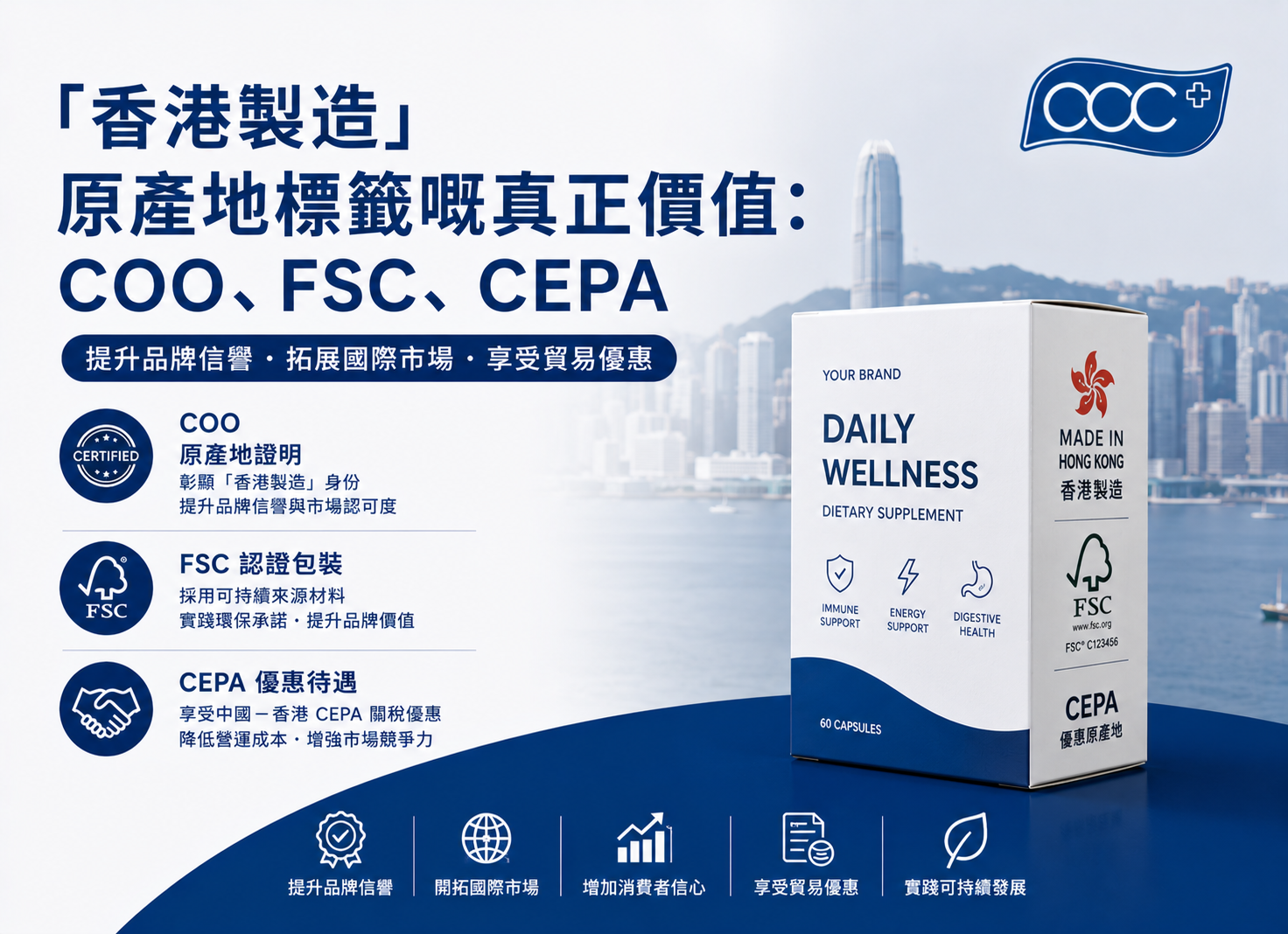
"Made in Hong Kong" carries serious commercial weight in the global supplement market — but most brand owners only ever see the label, not the three underlying documents that actually unlock its value. A Hong Kong origin claim is not just marketing copy; it is supported (or undermined) by a specific paperwork stack: the Certificate of Origin (COO), the Free Sale Certificate (FSC), and the Closer Economic Partnership Arrangement (CEPA) preferential trade documentation.
For brand owners launching premium supplement SKUs, understanding these three documents is the difference between a 30–50% retail price premium and a generic "Asian-made" perception. This guide breaks down each document, the markets where it matters most, the common pitfalls, and how ACC+ supports brand partners across all three layers.
The Certificate of Origin is the single most important document underpinning any "Made in Hong Kong" claim. Issued by the Hong Kong Trade and Industry Department (TID) or by approved bodies such as the Hong Kong General Chamber of Commerce, the COO certifies that the substantive transformation of the product took place in Hong Kong.
For supplement brand owners, the COO delivers value in three distinct ways:
The COO is not automatic. It requires the OEM to demonstrate that a defined percentage of value-add (formulation, blending, encapsulation, packaging, QC release) occurred at the Hong Kong facility — not just final labelling. Working with a true Hong Kong-based supplement OEM, rather than a re-export packer, is essential for a defensible COO.
The Free Sale Certificate, issued by the Hong Kong Department of Health, certifies that the supplement product is freely sold in Hong Kong and complies with local food and dietary supplement regulations. While the COO proves where the product was made, the FSC proves that it is legally and safely sold in its country of origin.
The FSC is mandatory or strongly recommended for product registration in numerous export markets, including:
The Hong Kong FSC carries weight internationally because the Hong Kong Department of Health is recognised as a credible regulatory authority. Brand owners who attempt to substitute the FSC with informal "supplier letters" or unofficial declarations typically fail registration on the first round.
The Closer Economic Partnership Arrangement (CEPA) between Hong Kong and mainland China is the third pillar of "Made in Hong Kong" value. Under CEPA, qualifying Hong Kong-origin products enjoy zero-tariff or preferential-tariff entry into mainland China, plus a streamlined customs declaration process.
For supplement brand owners targeting the mainland Chinese market — by far the largest health and wellness market in Asia — CEPA delivers two concrete advantages:
CEPA qualification requires meeting specific rules-of-origin criteria (typically a minimum value-add threshold and/or specific manufacturing steps performed in Hong Kong). Generic relabelling or simple repackaging does not qualify. A genuine Hong Kong supplement OEM with full in-house production is the only reliable path to defensible CEPA eligibility.
Each document tackles a different commercial problem, and together they form an integrated brand-premium engine:
Stack all three, and "Made in Hong Kong" stops being a tagline — it becomes a defensible, document-backed positioning strategy. Brand owners who only invoke the label without securing the underlying paperwork are leaving margin, market access, and competitive defensibility on the table.
ACC+ operates a genuine Hong Kong-based supplement OEM facility — not a re-export or relabelling operation. Every supplement product manufactured at our Hong Kong factory is eligible for:
Our regulatory team works alongside the brand owner from formulation through shipment, ensuring that every document is in place before the product hits cross-border logistics. To explore how this integrates into a complete supplement OEM partnership, see our ACC+ One-Stop Supplement OEM Solution and Hong Kong as Your Greater China Gateway.
No. The COO is only issued when the product meets specific value-add and substantive-transformation criteria in Hong Kong. Simple relabelling of an imported bulk product does not qualify. To secure a defensible COO, the formulation, blending, encapsulation/filling, packaging, and QC release should all occur at a registered Hong Kong facility. Working with a vertically integrated Hong Kong OEM like ACC+ is the safest route.
No. The Free Sale Certificate (FSC) confirms that the product is legally sold in its country of origin (Hong Kong) and complies with local supplement regulations. A GMP certificate confirms that the manufacturing facility meets Good Manufacturing Practice standards. Both are important — FSC for market entry, GMP for production quality — and most export markets expect both.
Vietnam, Indonesia, the Philippines, the UAE, and most Middle Eastern and African markets either require or strongly prefer the FSC for supplement product registration. Even when not strictly mandatory, the FSC accelerates approval and reduces the risk of rejection. Confirm the latest requirements with the destination market's regulator before submission.
It depends on the HS classification, but for most qualifying supplement categories CEPA reduces import tariff from the standard 5–15% range down to 0% or near-0%. On a container-scale shipment, this typically represents tens of thousands of HKD in direct tariff savings, plus margin improvement from faster customs clearance.
No. A Hong Kong COO can only be issued for products with substantive manufacturing in Hong Kong. Mainland-produced supplements that are simply repackaged or relabelled in Hong Kong do not qualify, and false origin claims expose the brand owner to significant legal and reputational risk. Always verify your OEM's Hong Kong production credentials before launching with a "Made in Hong Kong" positioning.
CEPA covers a broad range of supplement HS codes, but specific eligibility depends on the product's classification and the rules of origin for each category. Some niche or novel ingredients may fall outside the standard preferential list. ACC+'s regulatory team pre-validates CEPA eligibility for every Greater-China-targeted SKU before production.
Once the production batch is complete and QC documentation is finalised, the COO is typically issued within 3–7 working days, and the FSC application processing time at the Department of Health typically ranges from 2–4 weeks depending on workload. ACC+ pre-prepares the documentation packet during the production timeline so paperwork lands in parallel with finished goods.
"Made in Hong Kong" carries stronger international regulatory credibility, stronger consumer quality association in Greater China, FSC-backed export access to ASEAN and the Middle East, and CEPA-backed preferential entry back into mainland China. "Made in China" is a broader and more commoditised positioning that typically delivers lower retail price points and faces stricter scrutiny in some export markets. For premium-positioned supplement brands, the Hong Kong origin stack is a meaningful competitive moat."Made in Hong Kong" carries serious commercial value for supplements — but most brand owners only know the label, not the three documents that underpin it. This article breaks down COO, FSC and CEPA.
Certifies free sale in Hong Kong; mandatory for registration in Vietnam, Indonesia, the UAE and more.
Tariff and customs preferences under the Closer Economic Partnership Arrangement.
ACC+'s Hong Kong factory delivers genuine COO, COP, FSC and CEPA support. See ACC+ One-Stop Solution and Hong Kong as Greater China Gateway.