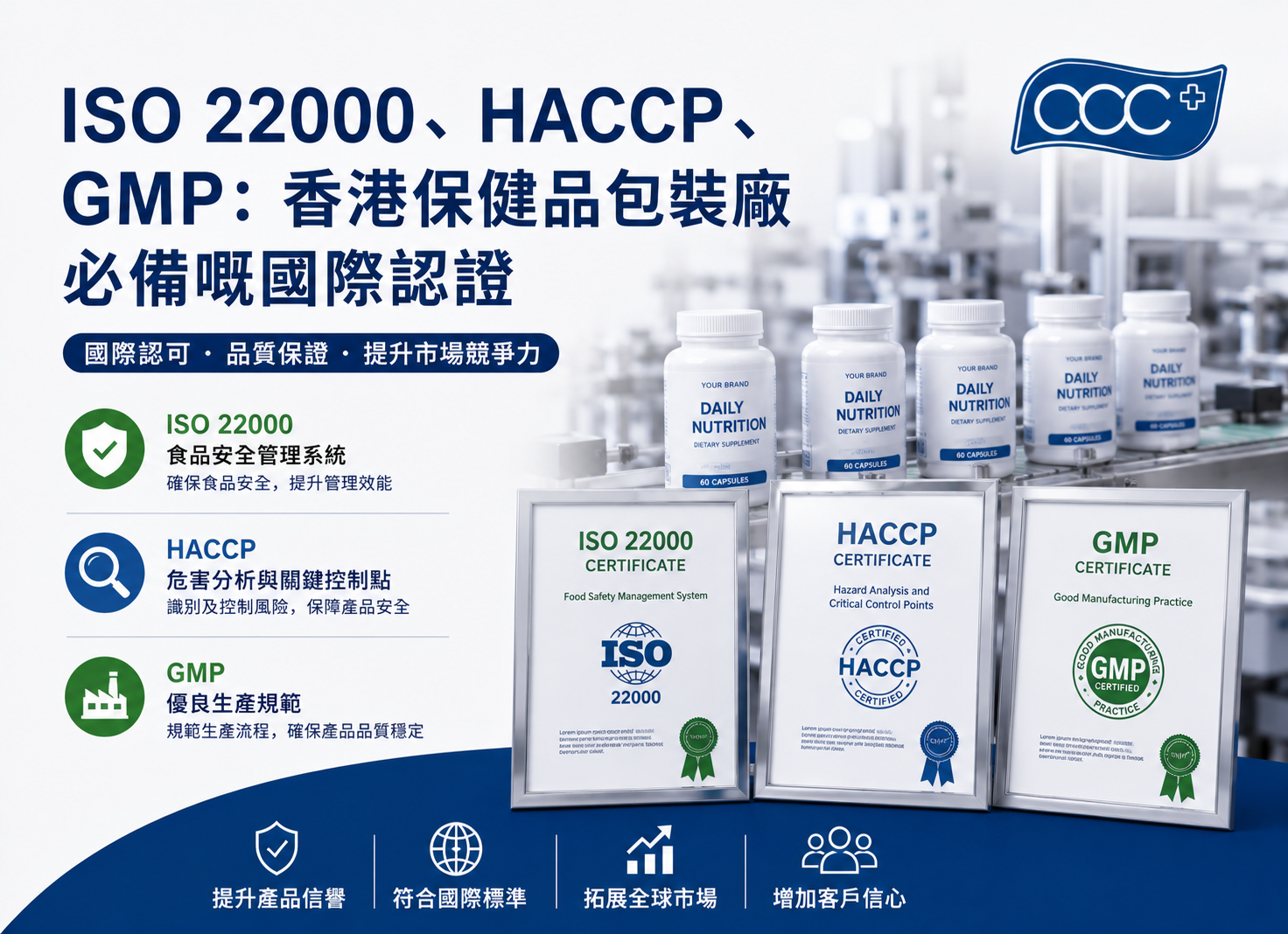
When a brand owner shortlists a Hong Kong supplement OEM, three letters keep appearing in every quotation: ISO 22000, HACCP and GMP. They are not interchangeable badges of honour — each one sits at a different layer of the quality system, and serious export markets expect to see all three. This guide explains what each certification actually covers, how they relate to one another, why exporters to the EU, USA, ASEAN and the Middle East increasingly insist on the full stack, and the audit questions every brand owner should ask before signing an OEM contract.
ISO 22000 is the international standard for a food safety management system (FSMS) covering the entire chain — from raw material sourcing to finished-goods retail. For supplements, it sets expectations around documented standard operating procedures, supplier qualification, batch traceability, complaint handling and management review. An ISO 22000 certificate signals that the factory does not just manufacture safely, but runs a system that can be audited end-to-end.
For brand owners, ISO 22000 means: if a problem occurs in a batch, the OEM can trace upstream to the supplier and downstream to the customer within hours, not days.
HACCP is the preventive risk layer. Rather than relying on end-product testing alone, HACCP requires the factory to systematically identify biological, chemical and physical hazards at every step of the process, then design critical control points (CCPs) where those hazards are eliminated or reduced to acceptable levels.
Typical CCPs in supplement manufacturing include raw-material acceptance criteria, metal detection on the filling line, validated heat or sterilisation steps for sensitive ingredients, and sealed-packaging integrity checks. HACCP plans are reviewed annually and updated whenever a new product, ingredient or process is introduced.
GMP is the production-floor baseline. It governs facility design, equipment qualification, personnel hygiene, cleaning validation, in-process controls and documentation discipline. Different markets reference slightly different GMP standards — NMPA GMP for mainland China, FDA 21 CFR Part 111 (cGMP for dietary supplements) for the US, and EU GMP-aligned frameworks for European nutraceuticals — but the underlying principles overlap significantly.
Without GMP, ISO 22000 and HACCP are paperwork without a foundation. With GMP alone, the factory may run cleanly but lacks the management-system maturity that export buyers demand.
Many brand owners ask whether one certification can substitute for another. The honest answer is no — they sit at different layers and reinforce each other:
A factory that holds all three has demonstrated competence at the floor level, the process level and the management level. That is what international buyers, hospital channels and large e-commerce platforms increasingly expect before they place a serious order.
Different destination markets weight the three certifications differently:
Before signing with any Hong Kong supplement OEM, brand owners should request and verify:
ACC+ holds ISO 22000, HACCP and GMP and integrates all three into a single quality system covering formulation, blending, filling, packaging, QC release and warehousing. For brand owners this means a single accountable partner across the certification stack, not a stitched-together chain of sub-suppliers. See also GMP / HACCP / NMPA FAQ for Supplement OEM and Hong Kong Supplement Certifications Overview.
No. HACCP is a preventive hazard-analysis methodology. ISO 22000 is a full food safety management system that incorporates HACCP principles and adds management-system requirements such as documented SOPs, internal audits and continual improvement.
In theory yes — GMP and HACCP are separate certifications. In practice, any factory exporting to international markets is expected to operate HACCP-aligned processes regardless of whether the certificate is displayed.
FDA's 21 CFR Part 111 sets cGMP for dietary supplements. It covers personnel, plant and grounds, equipment, production and process controls, packaging and labelling, holding and distribution, returns and complaints.
For products making health-function claims sold as 保健食品 (health food), Blue Hat (蓝帽子) registration is required. For general food-supplement positioning under cross-border e-commerce, lighter regimes may apply, but NMPA GMP at the manufacturing side remains important.
Typically on a three-year cycle with annual surveillance audits. Certificates older than the surveillance window or without recent audit evidence should raise immediate concern.
EU GMP is harmonised across member states and is most strictly applied to medicinal products, with nutraceuticals often referenced via aligned frameworks. FDA 21 CFR Part 111 is specifically scoped for dietary supplements in the US. Both demand documented procedures, qualified equipment and traceable batch records.
Yes. ACC+ supports brand owners with documentation aligned to EU, US, ASEAN and Middle East market requirements, including certificate of origin, COA, BSE/TSE statements, allergen declarations and stability data, alongside the core ISO 22000, HACCP and GMP certifications.
A certificate whose scope does not cover the product or process being commissioned. A factory may hold valid GMP for one product line but not for the one your brand wants to manufacture. Always check the scope statement, not just the certificate logo.