Hong Kong supplement brands often think about formulation, design and marketing first — but the silent killer of brand reputation is what happens between the production line and the consumer's hand. Supplements can spend two to six months in warehousing, transit and customs before they are consumed. Without proper temperature, humidity and security controls, actives can degrade by more than 30% over that window, probiotics can lose viability, fish-oil and omega-3 capsules can oxidise, and entire batches can become unsellable.
This guide explains how a professional Hong Kong supplement warehousing and cold-chain logistics setup should be designed, what climate-controlled storage really means, how cold-chain shipping for probiotics and refrigerated formulas is engineered, and what OEM brand owners should demand from a Hong Kong contract manufacturer before committing inventory.
Any credible Hong Kong supplement warehouse should be built around three control pillars that work together — not in isolation.
General supplement storage targets 15–25°C, with tighter 18–22°C for sensitive softgels, probiotics and effervescents. Hong Kong's summer routinely exceeds 33°C with high humidity, so air-conditioned ambient storage is the absolute minimum — uninsulated industrial space is not acceptable for finished goods. Mapping studies should verify that hot spots near loading bays, ceilings and doorways stay within range.
Relative humidity should be held at RH 45–65% for most tablets, capsules, powders and gummies. High humidity accelerates moisture migration into hygroscopic ingredients (vitamin C, B-vitamins, collagen peptides), causes capsule sticking, and shortens shelf life. Dehumidification, sealed loading airlocks and HVAC scheduling all matter.
A pharmaceutical-grade warehouse needs 24-hour CCTV coverage, access logging, restricted-area zoning for high-value or temperature-sensitive SKUs, and audit-ready visitor records. This is not paranoia — it is what an EU, ASEAN or Middle East buyer will ask for during a due-diligence visit.
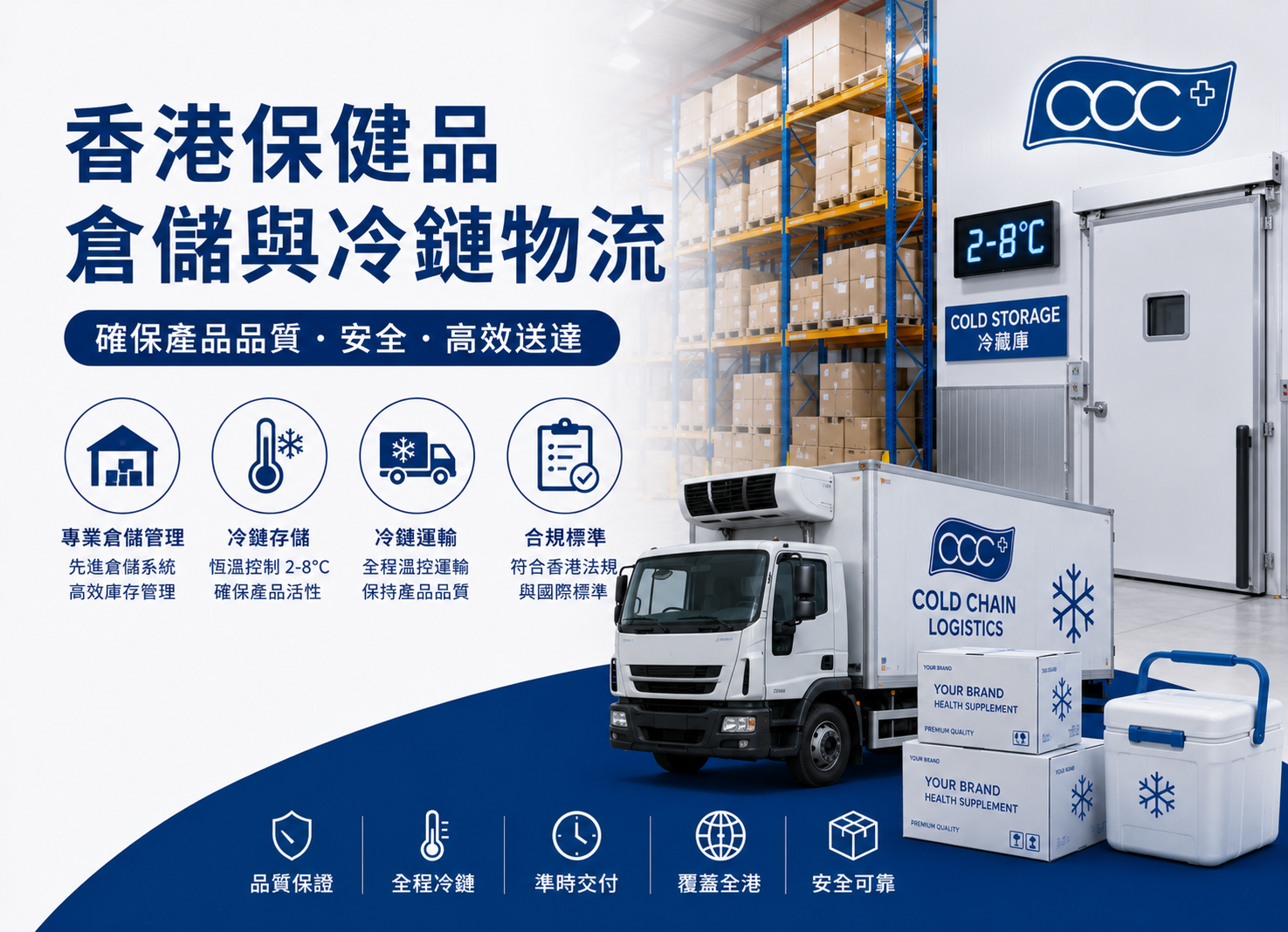
Not every supplement needs cold chain — but the ones that do, need it without compromise. A serious Hong Kong supplement OEM partner should support at least four cold-chain scenarios:
Each scenario requires the right combination of refrigeration equipment, insulated packaging, temperature data loggers, and standard operating procedures for what happens when a temperature excursion is detected.
Large multinationals can absorb a written-off batch. For a young Hong Kong supplement brand, a single expiry-loss event or a humidity-damaged shipment can wipe out a quarter's margin. Poor storage controls cash flow in three ways:
Outsourcing finished-goods storage to a Hong Kong contract manufacturer with a built-in ERP inventory system removes most of these risks at the source.
A modern Hong Kong supplement warehouse should run on an ERP-based inventory system rather than spreadsheets. Brand owners should expect real-time SKU-level stock visibility, lot and expiry tracking, automatic FIFO/FEFO (first-in-first-out / first-expiry-first-out) picking, and exportable reports for sales channels in Hong Kong, mainland China and overseas. When the same system is connected to QA records, batch certificates of analysis, and shipment documentation, traceability becomes a competitive advantage rather than an audit burden.
Hong Kong's geographic position is a structural advantage for supplement brands targeting the Greater Bay Area, ASEAN and the Middle East. A properly designed warehousing setup should integrate with:
ACC+ integrates climate-controlled finished-goods warehousing, refrigerated cold-chain capability, ERP inventory and outbound logistics inside its Hong Kong manufacturing campus. For brand owners this means a single accountable partner across formulation, GMP filling, QC release, warehousing and shipment — rather than juggling three or four vendors and praying the hand-offs hold up under audit. See also ACC+ One-Stop Hong Kong Supplement OEM Solution and Why Choose Hong Kong Supplement OEM.
General finished-goods storage should target 15–25°C, with tighter 18–22°C for probiotics, softgels and effervescents. Refrigerated cold storage runs at 2–8°C, and frozen storage at around −18°C for sensitive raw materials.
Not all. Some strains are formulated to be shelf-stable at controlled ambient temperatures, but live-culture and high-CFU clinical formulations almost always require validated 2–8°C cold chain, particularly during Hong Kong's hot and humid summer months.
GDP stands for Good Distribution Practice, an internationally recognised standard for storage and transport of health products. GDP-compliant cold chain uses calibrated reefer vehicles, validated insulated packaging and continuous temperature monitoring, with documented procedures for handling excursions.
Through HVAC with active dehumidification, sealed loading airlocks, RH monitoring at multiple zones, and storage SOPs that limit how long pallets stay in transition areas. Target ranges of RH 45–65% protect tablets, capsules and powders from moisture-driven degradation.
FIFO ships the oldest stock first based on receiving date. FEFO ships based on the nearest expiry date — which is what supplements actually need, because shelf life rather than receiving order is what protects the consumer and the brand.
Within a validated climate-controlled environment, finished goods comfortably hold to their labelled shelf life — typically 18 to 36 months depending on format. The risk multiplies when storage is uncontrolled, when FIFO/FEFO is not enforced, or when products cycle through hot and humid loading areas repeatedly.
Yes. ACC+ supports cold-chain and controlled-ambient outbound shipments from its Hong Kong facility into the Greater Bay Area, mainland China, ASEAN and other export markets, using validated packaging, data loggers and GDP-aligned transport partners.
Ask for temperature and humidity mapping reports, ERP inventory screenshots with real SKU traceability, cold-chain validation records, CCTV and access logs, FIFO/FEFO SOPs, and reference cases of cross-border or export shipments. A serious partner will share these without hesitation.