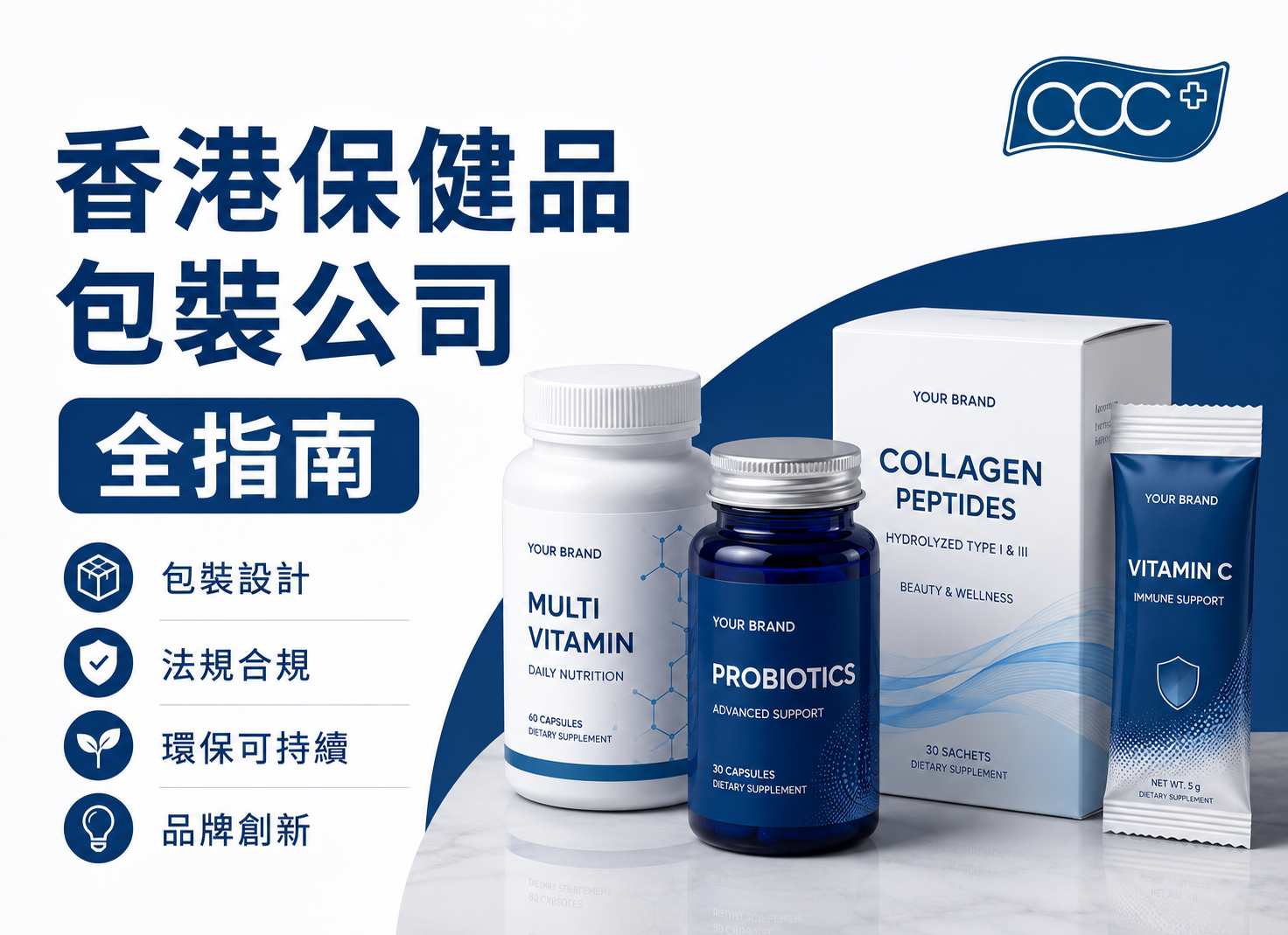
Hong Kong's health supplement market grows steadily year after year, yet many emerging brand owners underestimate the importance of packaging when they first approach contract manufacturing. From the moment a consumer picks the product off the shelf to the moment they open it at home, packaging defines the brand's first impression, the product's shelf life, the labelling compliance for each export market, and even whether the goods clear customs at all.
This guide walks you through the three categories of Hong Kong supplement packaging companies, the six must-check criteria for shortlisting one, the common pitfalls of working with pure co-packers, and why a one-stop OEM such as ACC+ is increasingly the safer choice for new brands and growing SMEs.
The keyword "Hong Kong packaging company" actually covers three very different service models. Many brand owners conflate them and end up with mismatched expectations on quotation, responsibility and lead time.
For a new brand, or for any brand planning to enter overseas markets, a one-stop OEM is generally the lower-risk choice. Packaging is part of the regulated manufacturing chain — when responsibility is split across three vendors, every problem turns into a finger-pointing exercise.
Whichever category you choose, screen every shortlisted Hong Kong supplement packaging company against these six criteria:
Co-packers often quote lower unit prices, which is attractive on paper. In practice, however, the hidden costs add up quickly for brand-building entrepreneurs:
A one-stop OEM such as ACC+ runs formulation, dosage-form selection, ingredient sourcing, GMP production, packaging, QC release and export documentation under a single project manager. The brand owner has one accountable counterparty rather than three or four. Internal coordination — between formula and dosage form, between dosage form and packaging, between QC and warehousing — happens inside the OEM rather than across your inbox.
This model is particularly powerful for new brands that need to move from concept to first shipment in months rather than quarters, and for established brands that want to consolidate vendor risk.
Choosing a packaging partner also means choosing a packaging format that matches your brand strategy:
ACC+ integrates ISO 22000, HACCP and GMP certifications, automated bottling, sachet and blister lines, climate-controlled warehousing, label compliance support and full export documentation inside a single Hong Kong facility. For brand owners, this means: one quotation, one project manager, one accountable partner — from raw material to ready-to-ship carton. See also ACC+ One-Stop Hong Kong Supplement OEM Solution and Hong Kong Supplement Warehousing & Cold Chain Guide.
A co-packer handles downstream packaging only — filling, labelling, combo-packing — using materials supplied by the brand. An OEM such as ACC+ covers the entire chain from formulation and ingredient sourcing through production, packaging, QC release and export documentation.
At minimum ISO 22000, HACCP and GMP. Brand owners targeting the EU, US, ASEAN or Middle East should also ask about export-aligned documentation capability such as COO, FSC, BSE/TSE statements and Halal certification.
Flexible OEMs in Hong Kong typically offer small trial-batch MOQs to allow new brands to validate the market before committing to mass production. The exact figure depends on dosage form, packaging format and ingredient cost — discuss it openly during the first quotation round.
Pure co-packers usually do not. One-stop OEMs such as ACC+ support brand owners with Certificate of Origin (CO/COO), Free Sale Certificate (FSC), CEPA-related paperwork and other market-specific documents, which is critical for Greater Bay Area, ASEAN and Middle East exports.
Significantly. Moisture-barrier, oxygen-barrier and light-barrier properties of the chosen container, the integrity of induction seals, and storage conditions all directly affect the stability of vitamins, probiotics and oxidation-prone actives such as omega-3.
Yes, and many brands do exactly this once early SKUs validate demand. A reputable Hong Kong OEM will conduct a transition gap analysis covering formula re-qualification, label revision, certification scope and inventory transfer.
Pure co-packing of an existing brand can take a few weeks once materials arrive. A full OEM project — including formulation, raw-material qualification, pilot run, label design and first production batch — typically runs across a few months, depending on dosage form complexity and certification needs.
Yes. ACC+ supports new brand owners with low-MOQ trial runs and end-to-end onboarding, and also serves established brands that want to consolidate vendor risk by moving multiple SKUs onto a single accountable OEM partner.