Walk into any Hong Kong pharmacy, supermarket or health-food shop and the first thing you notice on a supplement bottle is bilingual text: Traditional Chinese on one side, English on the other, often interleaved with allergen warnings, ingredient declarations and lot codes. That label is not a marketing surface — it is a regulated legal document. Get any field wrong, miss a font-size threshold, or misalign a translation, and your batch can be detained by the Centre for Food Safety (CFS), pulled from retail shelves, or rejected at the port of a downstream export market.
This in-depth 2026 guide explains exactly what Hong Kong requires on a bilingual supplement label, how the rules interact with the 1+7 nutrition labelling framework, what counts as a permitted versus prohibited claim, how allergen declarations should be structured, and how to design a single artwork system that scales across Mainland China, ASEAN, GCC, US and EU export markets. We close with common label rejections, an extended FAQ, and where ACC+ fits in as a Hong Kong GMP OEM partner.
Hong Kong supplement labelling sits primarily inside the Public Health and Municipal Services Ordinance (Cap. 132) and its subsidiary regulations — most importantly the Food and Drugs (Composition and Labelling) Regulations (Cap. 132W). These set out the mandatory label fields, the bilingual requirement, the rules on legibility and durability, and the framework under which the Centre for Food Safety inspects retail and import compliance.
Supplements that cross into therapeutic claims fall under a different regime: the Pharmacy and Poisons Ordinance (Cap. 138) regulates products that claim to treat, prevent or cure disease. The line between a permitted nutritional claim and a regulated therapeutic claim is one of the most frequently misunderstood — and most frequently penalised — areas of Hong Kong supplement labelling. We cover this in detail in section 4.
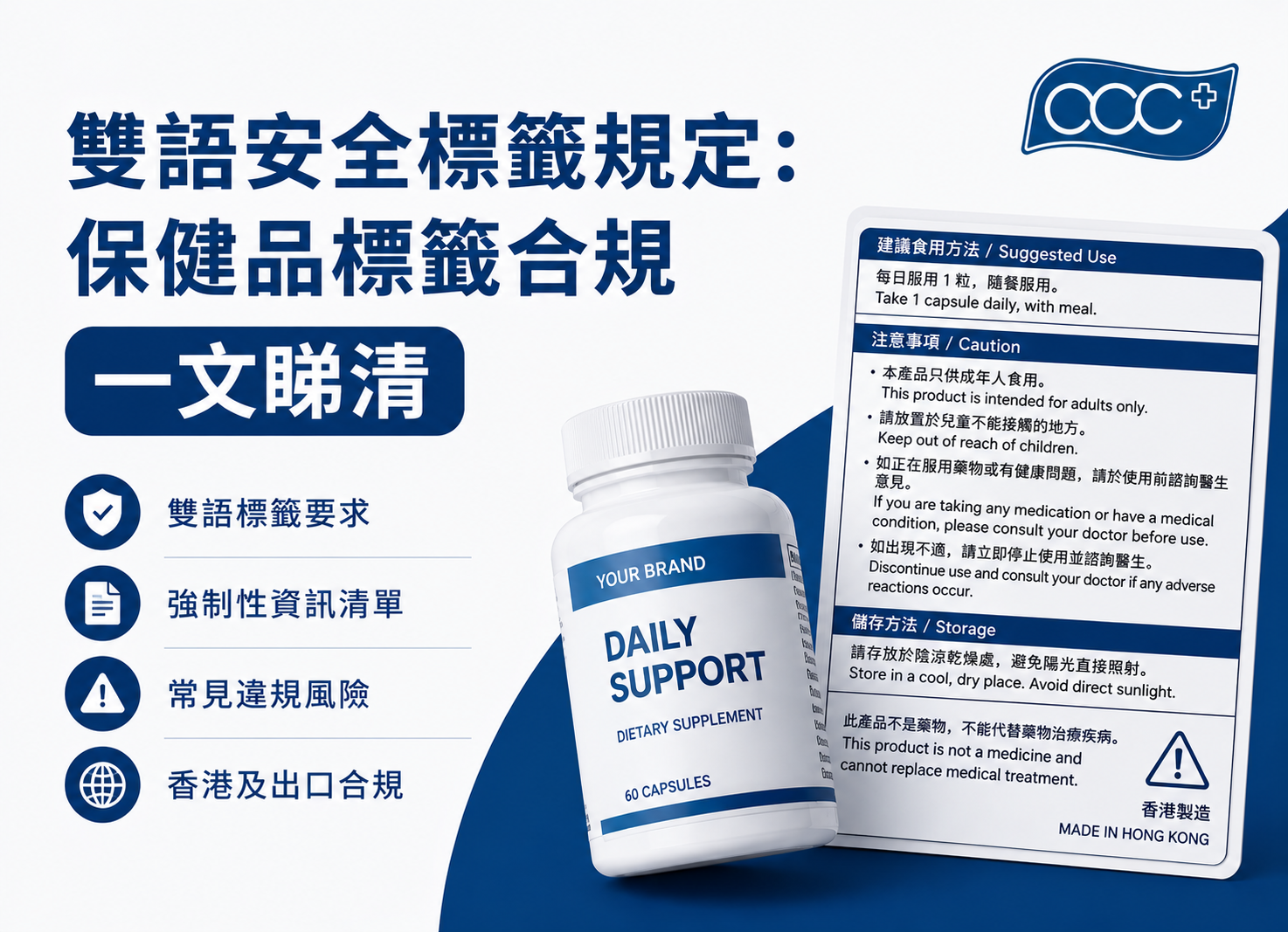
Every prepackaged supplement sold in Hong Kong must carry the following information, in both Traditional Chinese and English, on the outermost packaging that reaches the consumer:
Product name — the name by which the product is sold, presented in both languages with equivalent prominence. Fanciful brand names must be accompanied by a true description of the food.
Ingredient list — all ingredients in descending order of weight at the time of incorporation, with bilingual names. Compound ingredients with more than 5% by weight must be broken down to their sub-ingredients.
Allergen declaration — the eight categories defined under Hong Kong rules: cereals containing gluten, crustaceans, eggs, fish, peanuts, soybeans, milk, tree nuts. Also sulphites at or above 10 mg/kg.
Net quantity — declared in metric units (g, kg, mL, L) and visible without opening the package.
Best-before or use-by date — clearly worded and bilingual. DD/MM/YYYY format is standard for Hong Kong.
Storage and use instructions — where the product requires specific storage conditions or where misuse would compromise safety or efficacy.
Name and address — of the manufacturer, packer, or seller responsible for the product in Hong Kong.
Country of origin — where the product was made or undergone its last substantial transformation.
Nutrition labelling — under the 1+7 framework (energy plus 7 core nutrients) for products with nutrition claims or general retail supplements above defined thresholds.
Lot or batch code — for traceability; format is producer-defined but must be retrievable for recall.
The bilingual requirement is not a translation checkbox — it is a layout requirement. Hong Kong inspectors look for parity in three dimensions:
Neither language can be appreciably smaller, fainter, or harder to read than the other. The mandatory minimum legibility is set against an x-height threshold (the height of a lowercase 'x') typically interpreted at 1.2 mm for general-purpose labelling, with the understanding that small-package exemptions allow proportional reductions. Stylistic choices like very thin sans-serif fonts, low-contrast colours and reflective foils can each push your label below the legibility threshold even when the absolute size meets the rule.
Both languages must be visible simultaneously without rotating or unfolding the package. A label that puts English on a peelable flap or hides Chinese on a tertiary panel does not meet the requirement. For cylindrical bottles, this typically means bilingual content on a single wrap-around label or on adjacent front/back panels.
The Chinese version must convey the same meaning as the English version with equivalent specificity. Loose paraphrasing of medical-adjacent terms is a common failure point. INCI-style English ingredient names should be paired with their official Chinese counterparts as published in the China Food Composition Tables, the Hong Kong Centre for Food Safety glossaries, and recognised pharmacopoeia translations where applicable.
Claims are the single highest-risk area on a Hong Kong supplement label. The taxonomy below explains what each claim category requires and where the regulatory lines fall.
Statements about the level of a nutrient — 'high in vitamin C', 'low in sodium', 'source of fibre' — are permitted when the product meets the quantitative threshold defined under the Technical Guidance Notes on Nutrition Labelling and Nutrition Claims. For example, a 'source of vitamin C' claim requires the product to provide at least 15% of the NRV per 100 g (solids) or per 100 mL (liquids) or per serving as labelled.
'Reduced sugar', 'lower in fat' and similar comparative claims are permitted only when the comparison is to a clearly identified reference food and the difference exceeds the defined threshold (typically 25% reduction for nutrients, 25% increase for desirable components, with absolute minimums).
Function claims describe the physiological role of a nutrient — 'calcium helps build strong bones', 'vitamin D contributes to normal immune function'. These are tolerated when phrased generically and supported by widely recognised authoritative bodies (FAO/WHO, Codex). They become problematic when phrased as a benefit specific to the branded product or when they imply prevention of disease.
Claims that imply the product treats, prevents, cures, mitigates or diagnoses a disease are prohibited on supplement labels in Hong Kong. Examples that consistently trigger enforcement: 'cures arthritis', 'prevents cancer', 'treats depression', 'lowers blood pressure'. Products carrying such claims fall under the Pharmacy and Poisons Ordinance and require registration as pharmaceutical products. The line is policed strictly because the consumer protection logic underpinning it is fundamental: a supplement is not a substitute for medical treatment, and labelling that suggests otherwise is treated as a public health risk.
Claims targeting infants and young children, claims implying suitability for pregnant or lactating women, and claims around weight loss carry additional substantiation requirements and are heavily scrutinised. Hong Kong follows broadly the Codex Code of Ethics for International Trade in Food. Brands selling supplements in these categories should expect a higher artwork review burden.
Hong Kong requires explicit declaration of eight allergen categories when they are intentional ingredients: cereals containing gluten (wheat, rye, barley, oats, spelt), crustaceans, eggs, fish, peanuts, soybeans, milk and tree nuts. Sulphites at concentrations of 10 mg/kg or above must also be declared.
Best practice — and an emerging regulatory expectation across global markets — is to highlight allergens in bold or otherwise emphasised type within the ingredient list. A common compliant format is 'Contains: Milk, Soybeans' as a separate line below the ingredient list, in addition to bolded inline declarations.
Cross-contact warnings ('may contain traces of peanut') are voluntary but should be applied conservatively and only where a documented risk assessment supports them. Overuse of 'may contain' statements is increasingly viewed as obscuring genuine cross-contact risk and is discouraged by major importing authorities including the EU and US FDA.
Hong Kong's nutrition labelling rule — the '1+7' framework — requires declaration of energy plus seven core nutrients (protein, total fat, saturated fat, trans fat, carbohydrate, sugar, sodium) on prepackaged food products that make nutrition claims or that fall above small-package exemption thresholds. For supplement brands, three integration points matter:
Format and units — the nutrition information panel must use the prescribed format, with energy in kJ and kcal, and nutrient values in grams or milligrams per 100 g/mL and per serving, with the serving size clearly defined.
Tolerances — declared values must fall within defined analytical tolerances (typically ±20% for nutrients, with tighter limits for specific categories). Stability over shelf life must be considered when setting declared values.
Claim consistency — any nutrition claim made on the label must be mathematically consistent with the values declared in the 1+7 panel.
We cover the 1+7 framework in depth in our companion article, the Hong Kong 1+7 Nutrition Label Guide.
Few supplement brands sell only in Hong Kong. The smart artwork strategy is to design a core bilingual label that satisfies Hong Kong and treat each export market as an additive overlay. This avoids the trap of redesigning the entire label every time a new market opens.
Mainland China runs an entirely separate regulatory system. Products with function claims require 'blue-hat' registration as health foods (保健食品); vitamin/mineral supplements on the positive list may use the filing route. Mandatory label elements are similar in spirit but different in detail — Simplified Chinese only, GB standards for nutrition labelling, and specific approval numbers must appear on the front of the package.
Singapore, Malaysia, Thailand, Indonesia and the Philippines each have national labelling rules with some AHTN-level harmonisation. Halal certification (JAKIM, MUI, MUIS) is a retail-visibility requirement in most ASEAN markets even where not legally mandatory. Local-language labelling is required for Indonesia and Thailand.
GCC markets (Saudi Arabia, UAE, Qatar, Kuwait, Bahrain, Oman) require Arabic-language overlays, halal certification and — for Saudi Arabia in particular — SFDA registration for the supplement category. The Arabic translation must be reviewed by a qualified translator familiar with regulatory terminology.
US sales require a Supplement Facts panel rather than the Hong Kong 1+7 nutrition panel; a structure/function claim disclaimer ('These statements have not been evaluated by the FDA'); FDA establishment registration for the facility; and conformity with 21 CFR Part 101 labelling rules. Allergen declarations follow FALCPA categories.
EU sales require compliance with the Food Supplements Directive 2002/46/EC, EU Regulation 1169/2011 on consumer information, the Health Claims Regulation 1924/2006 (claims must be on the positive list), and national notification per member state. The 14 EU allergen categories overlap with but are not identical to Hong Kong's list.
Bilingual imbalance — Chinese text 30% smaller than English on the back panel, often introduced when a designer reuses an English-only template.
Ingredient list out of order — declared in label-design priority order rather than descending by weight at time of incorporation.
Therapeutic claims slipping in — 'helps with arthritis pain', 'naturally lowers blood pressure', 'cures fatigue' — all common rejections.
Allergens missing from the list but present in the formulation — typically caused by raw-material substitution after artwork was finalised.
Nutrition values inconsistent with claims — 'low sugar' on a product where the 1+7 panel shows 8.5 g/100 mL, well above the threshold.
Date format ambiguity — '03/04/2027' without specifying DD/MM or MM/DD.
Country of origin missing or vague — 'Made in Asia' is not a valid declaration.
Lot code missing or unreadable — typically caused by inkjet drift, low-contrast substrate, or poor placement over textured surfaces.
A defensible label is the output of a defensible artwork process. ACC+ operates a four-stage workflow that we recommend brand owners require from any OEM partner: (1) regulatory desk review of mandatory fields and claims against destination markets; (2) translation and bilingual layout by reviewers with regulatory terminology training, not generic copywriters; (3) on-press proofing under production conditions, including ink coverage, durability and tactile element verification; (4) batch-by-batch reconciliation of artwork version against the master batch record, with vision-system verification on the packaging line that the correct artwork is being applied to the correct SKU.
ACC+ operates as a fully integrated Hong Kong GMP OEM partner. Artwork management, regulatory review, bilingual translation, on-press proofing and packaging-line vision verification all run inside one organisation. Because formulation, filling, labelling and warehousing share a single quality system, label revisions for new markets, urgent corrections and recall communications flow through one batch master record rather than across vendor boundaries. See also our companion guides on the Hong Kong 1+7 Nutrition Label and the ACC+ One-Stop Hong Kong Supplement OEM Solution.
There is no single statutory font-size number; legibility is the legal test. As a practical baseline, x-heights of 1.2 mm and above on a contrasting background meet routine inspector expectations. For small-package products (below the prescribed surface-area threshold), proportional reductions are allowed but the bilingual equivalence rule still applies.
No. Prepackaged food products including supplements sold to consumers in Hong Kong require both Traditional Chinese and English on the labelling that reaches the consumer. Wholesale-only or business-to-business product transfers may have different requirements, but retail sale is firmly bilingual.
Nutrition content claims and generic function claims supported by recognised authoritative bodies are permitted within the framework. Therapeutic claims (treats, prevents, cures, mitigates, diagnoses disease) are prohibited and shift the product into the pharmaceutical regime under Cap. 138.
Allergens that are intentional ingredients must appear in the ingredient list. Best practice is to bold the allergen and add a 'Contains: ...' summary line below the ingredient list. Cross-contact 'may contain' warnings are voluntary and should be supported by a documented risk assessment.
Nutrition labelling is required for prepackaged food products with nutrition claims and for those exceeding the small-package exemption thresholds. Most retail supplements fall inside the requirement. The 1+7 framework applies: energy plus protein, total fat, saturated fat, trans fat, carbohydrate, sugar and sodium.
'Best-before' indicates the date until which the product retains its specific qualities under recommended storage. 'Use-by' indicates the date after which the product should not be consumed for safety reasons. Most supplements use 'best-before' dating supported by stability testing.
Lot codes are inkjet- or laser-printed in-line on the packaging line from the batch master record. Printing the lot as static artwork is not compliant because it cannot vary per batch. Modern lines integrate coder data directly from the batch system to eliminate manual transcription errors.
DD/MM/YYYY is the standard Hong Kong format. Alphabetic month names (e.g. 'BB: 31 JAN 2028') are also acceptable and reduce ambiguity for export markets. Avoid pure-numeric MM/DD/YYYY as it conflicts with Hong Kong convention.
With a complete dossier (formulation locked, stability data on file, claim list finalised), bilingual artwork review and approval at a GMP OEM partner like ACC+ typically takes 5–10 working days. Multi-market artwork (Hong Kong plus China plus ASEAN) adds time proportional to the number of regulatory overlays.
Yes. ACC+ operates a multi-market artwork system with regulatory review for Hong Kong, Mainland China, ASEAN, GCC, US and EU, plus on-press proofing and packaging-line vision verification. Contact us for a market-by-market dossier checklist.
CFS can issue a warning, demand corrective relabelling, detain the affected stock, or initiate prosecution depending on severity. For minor cosmetic non-compliance, corrective sticker overlays may be allowed; for substantive issues (missing allergen, therapeutic claim, false ingredient list), the stock is typically held until a corrective action plan is approved.
Any raw material substitution must trigger a change-control review that re-evaluates the ingredient list (order may change with weight changes), allergen profile (new supplier may carry different allergens), and analytical specification (which may shift declared nutrition values). Artwork must be re-released through the same workflow as a new SKU.