Many Hong Kong brand owners build skincare and supplement lines side by side — and naturally hope to consolidate production under a single OEM partner. On the surface, a "one-stop" cosmetic and supplement factory sounds efficient. In practice, cosmetics and dietary supplements diverge so fundamentally in regulation, facility design, packaging engineering, and quality testing that running them through the same production line is almost always non-compliant — and can put both your product registrations and your brand reputation at risk.
This guide walks cross-category brand owners through the four core areas where cosmetic packaging and supplement packaging differ, and outlines the OEM partnership model that keeps your brand consistent on the shelf while keeping each category fully compliant behind the scenes.
The first and most important difference is regulatory. In Hong Kong, cosmetics and supplements fall under entirely separate legal frameworks, each with its own labelling rules, safety testing requirements, and enforcement bodies.
What this means operationally: a single OEM cannot apply one quality manual to both categories. Cosmetic batches require ingredient compatibility testing for skin contact; supplement batches require microbiological, heavy metals, and stability testing aligned with food and nutraceutical standards. Combining them under one quality system is not just inefficient — it usually fails third-party audits.
The second non-negotiable difference is facility design. Cosmetic and supplement production lines cannot share air-handling, washing areas, weighing rooms, or filling lines. The reason is contamination risk:
A properly certified facility will operate two physically separated production areas — often on different floors with independent HVAC systems, separate gowning protocols, and segregated raw material warehouses. Cosmetic OEM facilities are audited against ISO 22716 (Cosmetics GMP); supplement OEM facilities are audited against GMP, HACCP, and ISO 22000. The two certifications are not interchangeable, and a facility that claims to do both under one roof should be inspected very carefully.
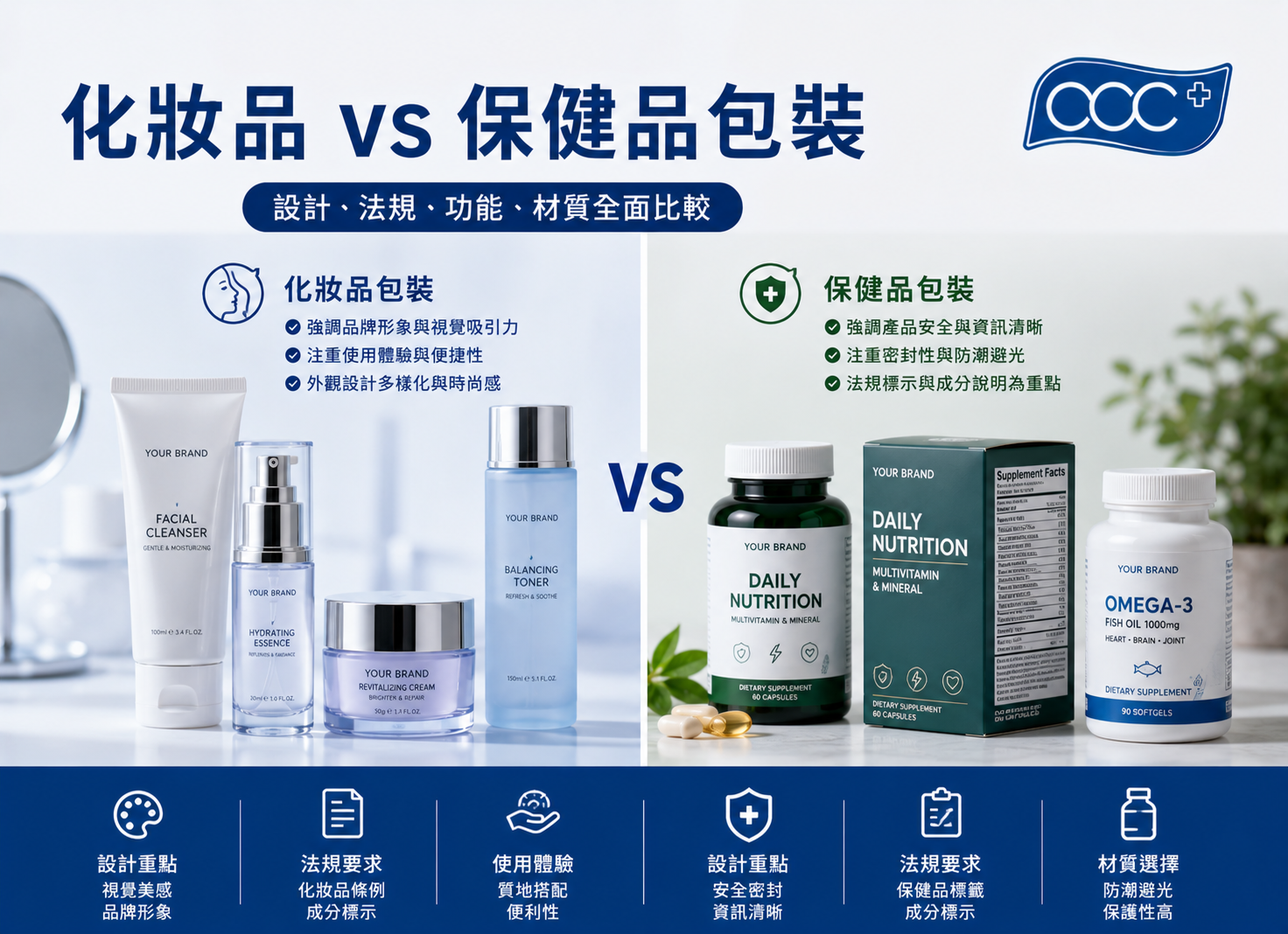
Even when the product inside is similar (for example, a collagen serum vs an oral collagen drink), the packaging itself is engineered around completely different priorities.
Print specifications also differ. Cosmetic labels prioritise visual finish — embossing, foiling, holographic effects. Supplement labels are dictated by regulatory content blocks, font-size minimums, and bilingual layout. Trying to print both on the same line, with the same ink sets and the same QC criteria, leads to either over-engineered supplement labels or under-compliant cosmetic ones.
If you run both a cosmetic line and a supplement line under one parent brand, the cleanest operating model is to separate production but unify branding. Specifically:
ACC+ focuses exclusively on dietary supplement OEM, ODM, and OBM. We do not operate cosmetic production lines, which is a deliberate decision: it allows us to maintain a dedicated GMP, HACCP, and ISO 22000-compliant facility, a single quality system tuned for nutraceutical manufacturing, and a focused R&D team that specialises in ingredient bioavailability, stability, and Greater China regulatory compliance.
For brand owners with a cross-category portfolio, ACC+ can recommend trusted ISO 22716-certified cosmetic OEM partners in our network, while we handle the supplement side end-to-end — from formulation and ingredient sourcing through to packaging design, regulatory labelling, and Greater Bay Area logistics.
To learn more about how a supplement-only OEM partnership works in practice, see our ACC+ One-Stop Supplement OEM Solution and Why Choose Hong Kong as Your Supplement OEM Base.
Only if the facility maintains fully separated production zones — different floors or completely isolated areas with independent HVAC, gowning, weighing, and warehousing — and holds both ISO 22716 (for cosmetics) and GMP/HACCP/ISO 22000 (for supplements). In practice, very few facilities in Hong Kong or the Greater Bay Area meet this standard. For most cross-category brand owners, using two specialist OEMs is faster, cheaper, and lower-risk than searching for a true dual-certified factory.
ISO 22716 is the international Good Manufacturing Practice standard specifically for cosmetics, covering skin-contact product safety, traceability, and ingredient handling. GMP for supplements (often combined with HACCP and ISO 22000) is built around oral ingestion — covering food-grade raw materials, microbiological safety, allergen control, and nutritional accuracy. The two are not interchangeable, and regulators in Hong Kong, Mainland China, and ASEAN markets treat them as separate certification tracks.
Not necessarily. A single packaging design partner can handle both, provided they understand the regulatory content blocks required for supplements (1+7 nutrition panel, bilingual safety warnings, allergen statements, batch/lot codes) and the finish-driven priorities of cosmetics (substrate selection, foiling, embossing, colour calibration). Using one designer across both categories actually strengthens brand consistency on the shelf.
The 1+7 scheme requires every pre-packaged supplement sold in Hong Kong to declare energy plus seven core nutrients — protein, total fat, saturated fat, trans fat, carbohydrates, sugars, and sodium — in a standardised format and font size. This is mandatory for the supplement side of your portfolio but does not apply to cosmetics. A specialist supplement OEM will pre-validate every label against the 1+7 requirements before production.
At minimum: GMP, HACCP, and ISO 22000. Stronger partners will also hold ISO 9001 (quality management), and many also pursue NSF, Halal, Kosher, or organic certifications depending on target markets. For cosmetics, the equivalent baseline is ISO 22716. Always request audit reports and certificate copies — never accept verbal claims.
Yes. While ACC+ focuses exclusively on dietary supplement OEM, we maintain working relationships with vetted ISO 22716-certified cosmetic manufacturers in Hong Kong and the Greater Bay Area. We can introduce you to a suitable partner so you can run both categories with specialist factories while keeping your brand identity unified.
For a brand launching one cosmetic SKU and one supplement SKU in parallel, a realistic timeline is 4–7 months from formulation brief to retail-ready inventory. Supplement side: 12–20 weeks (formulation, regulatory review, sample, pilot batch, mass production, labelling). Cosmetic side: 10–16 weeks (formulation, stability testing, filling, packaging). Running both tracks in parallel — coordinated through a shared design and project manager — saves significant time versus sequential launches.
Start with our One-Stop Supplement OEM Solution overview, then review Why Choose Hong Kong as Your Supplement OEM Base for the strategic rationale of using Hong Kong as your manufacturing hub.