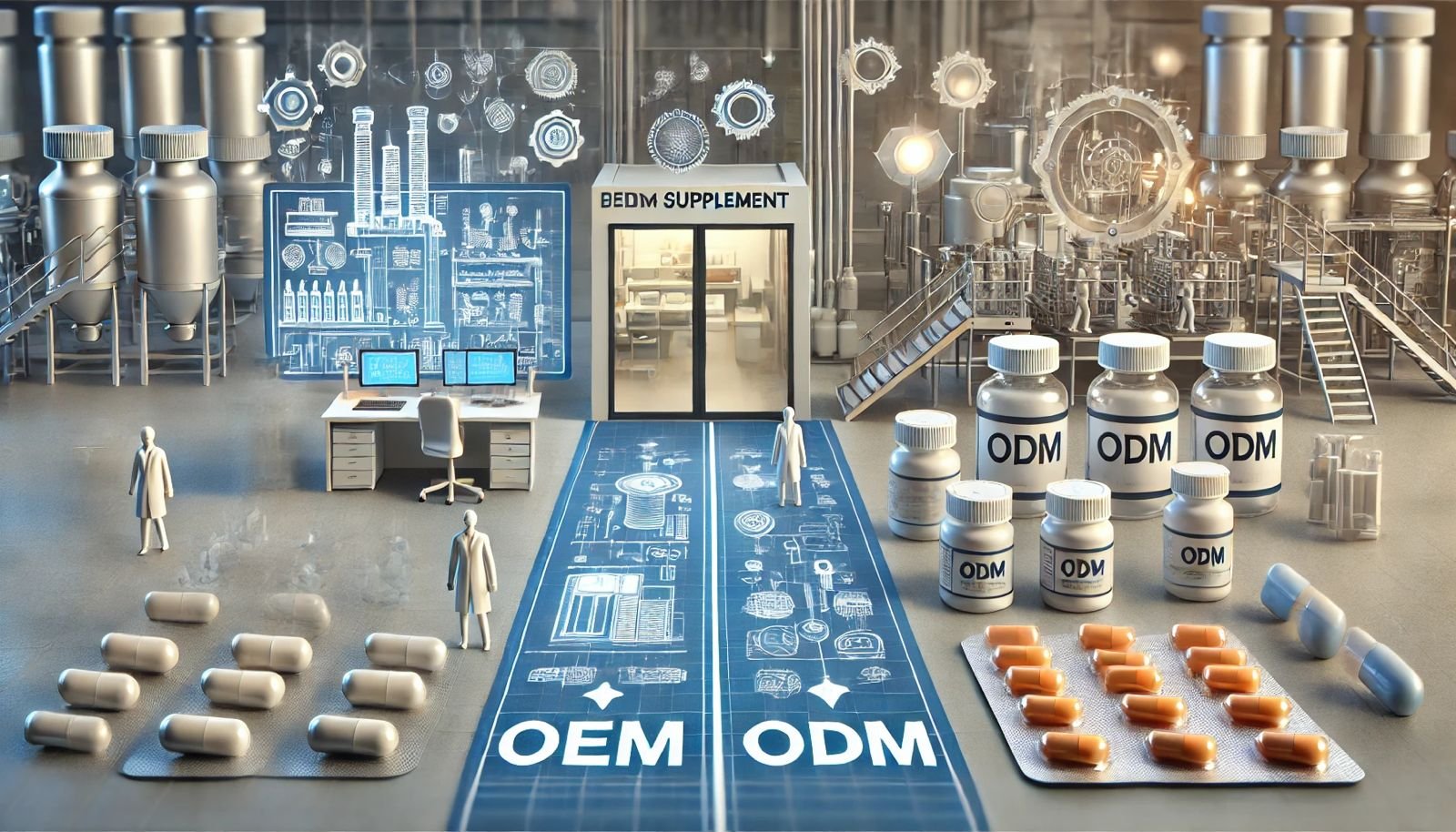
The fast-growing supplement industry pushes brands to find professional production partners. OEM and ODM are two common manufacturing models with significant differences in design, R&D investment, flexibility and IP. Here's a deep dive into both.
1. OEM: Brand-Led Contract Manufacturing
OEM stands for Original Equipment Manufacturer. The brand owner provides the product design, formulation and brand assets, and the factory produces the product to those specifications.
Key Characteristics of OEM
- Brand owner leads design and R&D — the brand fully controls product design, formulation, packaging style and other details. The factory only produces according to the brand's instructions
- Intellectual property belongs to the brand owner — since the design and technology come from the brand, the OEM factory has no rights to own or distribute the IP
- Scale and efficiency — OEM factories have large-scale capacity and can efficiently fulfil orders, ensuring a stable supply chain
Advantages of OEM
- Strong control: brand can monitor every step to match market positioning and brand identity
- Personalised customisation: ingredients, packaging and design fully tailored to the brand's needs
- Focus on marketing: the brand handles sales and promotion while production is outsourced to specialists
Brands That Suit OEM
- Established brands with their own proven formulations
- Brands that demand high product differentiation and full design/quality control
- Brands that need to protect core competitive advantages and trade secrets
2. ODM: Factory-Led Design and Production
ODM stands for Original Design Manufacturer. The factory provides ready-made formulations, design solutions and manufacturing technology. The brand simply selects a product and adds its branding.
Key Characteristics of ODM
- Factory provides complete design — from formulation to production. Brands can either adopt the design as-is or make minor modifications
- High time and cost efficiency — brands don't need heavy R&D investment and can focus on packaging and marketing
- Fast time-to-market — because base development is complete, brands can launch quickly and seize market opportunities
Advantages of ODM
- Lower R&D barrier — ideal for brands without strong technical capability or capital
- Diverse product options — factories typically offer multiple proven formulations
- Speed to market — new brands can enter the market quickly and gain first-mover advantage
Brands That Suit ODM
- Startups or new entrants to the supplement industry
- Brands that want to test market demand quickly
- Brands without internal R&D capability
3. OEM vs ODM: A Detailed Comparison
Design & R&D responsibility: OEM — brand owner; ODM — factory.
Product flexibility: OEM — high (fully customised); ODM — moderate (adjustments to existing formulations).
R&D investment: OEM — borne by brand; ODM — borne by factory.
Production responsibility: both — handled by the factory.
Product uniqueness: OEM — high, fully customised; ODM — depends on the factory's product line.
Time to market: OEM — moderate (needs design first); ODM — fast (proven products available).
Best-suited brands: OEM — mature brands with clear positioning; ODM — startups or rapidly expanding brands.
4. How to Choose Between OEM and ODM
The choice should depend on your brand's stage, resources and market goals.
Choose OEM When
- You already have clear market positioning and a product design plan
- You want a fully unique product to avoid being copied by competitors
- You have R&D budget for formulation development and testing
Choose ODM When
- You're a new brand wanting to test market demand quickly
- You lack technical and R&D resources but still want premium-quality products
- You're sensitive to market trends and want to use the factory's strengths to gain first-mover advantage
5. Choosing the Right Production Partner Is Key
Whether OEM or ODM, finding a professional manufacturer is critical. Look for the following:
- Certifications such as GMP and ISO to ensure production quality
- Relevant experience handling specific supplement formats (capsules, liquids, probiotics, etc.)
- Flexible cooperation models that fit different brand growth stages
Conclusion
OEM and ODM offer different paths for brand growth. OEM suits mature brands prioritising uniqueness and control; ODM is ideal for startups entering the market quickly. Either way, partnering with a professional manufacturer helps your brand grow efficiently and sustainably. If you have further questions, feel free to contact ACC Biotech — your supplement production specialists.